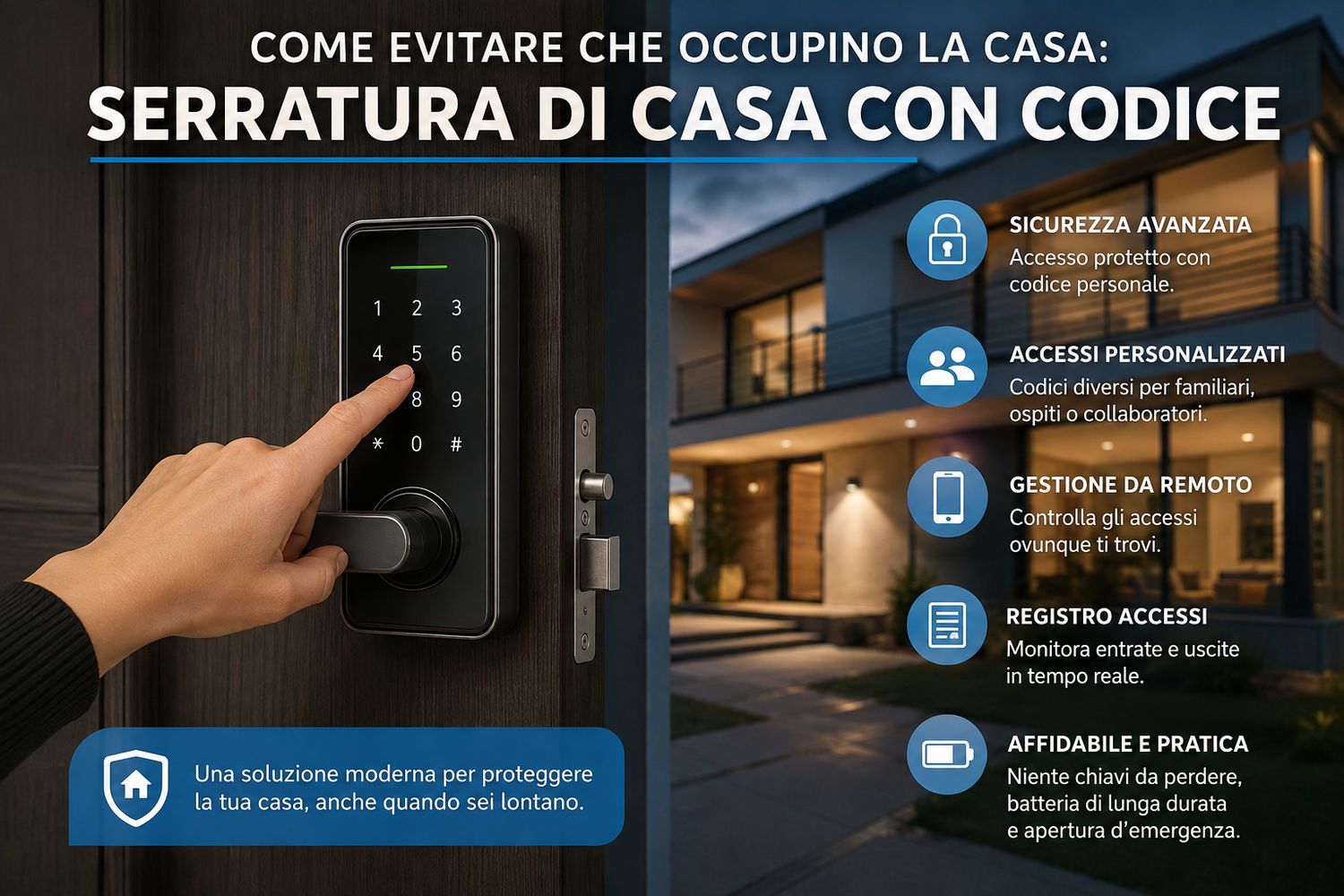
How to prevent someone from occupying your home: home lock with a code
When it comes to home security, the front door is the first point to protect. A home lock with a code can be a practical and modern solution for increasing security, eliminating the problem of lost keys, and making it easier to control who can enter the home.
But one question is becoming increasingly relevant: can a code lock really help prevent someone from illegally occupying a home?
The answer is yes, but with an important qualification: no lock can on its own prevent an illegal occupation, especially if the property is left empty for long periods. However, an electronic lock, as part of a broader security and monitoring system, can reduce certain risks and make it easier to monitor access.
Code lock: how does it work?
An electronic lock with a keypad allows you to open the door using a personal numerical code, without using a traditional key.
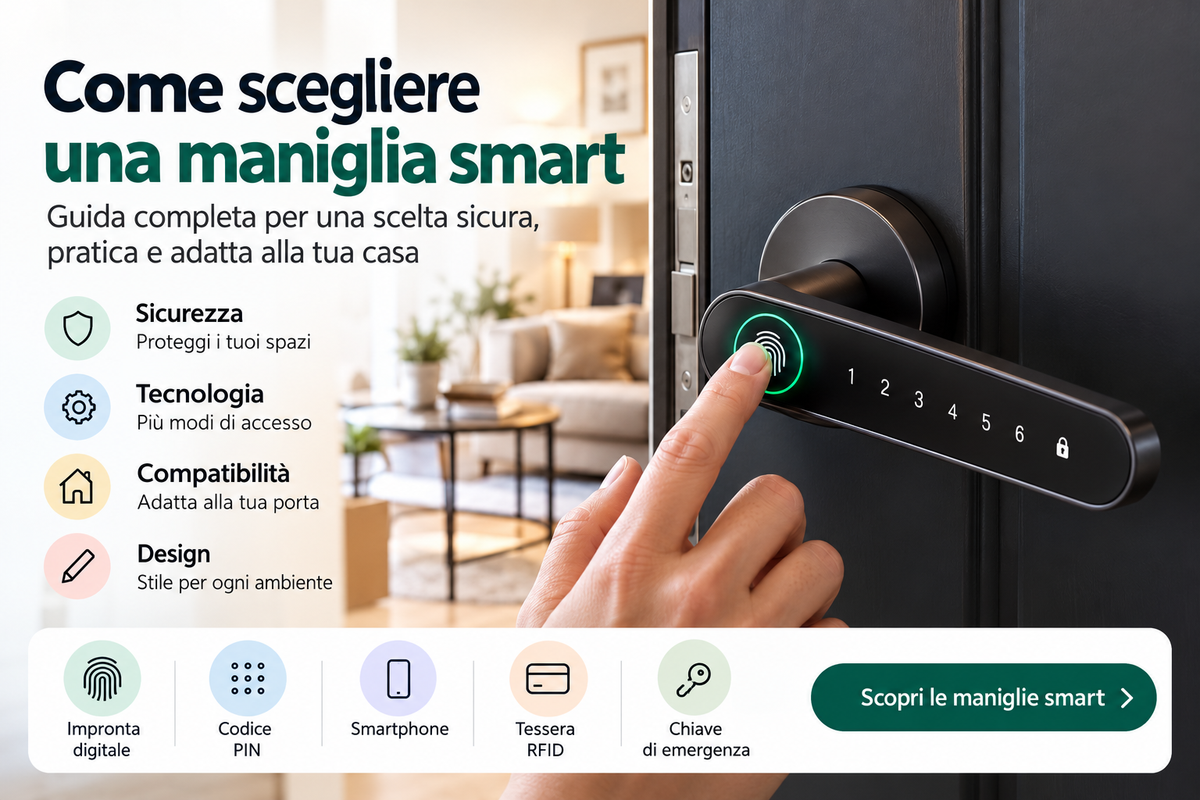
Depending on the model, it may offer several access methods:
-
-
-
PIN code;
-
smartphone via app;
-
Bluetooth;
-
Wi-Fi;
-
fingerprint;
-
RFID card or device;
-
emergency mechanical key.
-
-
The main advantage is the ability to manage access without having to hand over a physical key.
For example, if someone needs to enter the home to check the property, it is possible to provide a temporary code and later change or deactivate it.
Why can a code lock be useful for an empty home?
A home left empty for weeks or months may be more vulnerable. Having a good security door is not enough if no one regularly checks the property.
A smart lock can therefore become one element of a broader security strategy.
1. No hidden keys
Leaving a spare key under the doormat, inside a mailbox, or in other easily identifiable places is a risky practice.
With a code lock, there is no need to hide a key outside.
2. Custom and temporary codes
One of the most interesting features is the ability to create different codes for different people.
For example:
-
-
-
owner;
-
family member;
-
domestic worker;
-
technician;
-
real estate agent;
-
maintenance worker.
-
-
A temporary code can be used only for the necessary period and then deactivated.
3. Access control
The most advanced models let you know when the lock has been used and, in some cases, which user accessed it.
This provides greater visibility into what is happening around the home.
4. Remote management
Smart locks connected to the Internet can allow some functions to be managed even when the owner is not physically at home.
This feature can be particularly useful for:
-
-
-
second homes;
-
apartments temporarily left vacant;
-
rental properties;
-
homes used for short stays;
-
homes of people who travel frequently.
-
-
Coded lock or traditional lock?
The question should not necessarily be which of the two is "more secure."
An electronic lock with a code mainly offers greater control and flexibility in managing access. A good-quality mechanical lock, on the other hand, can provide high physical resistance to tampering.
The most interesting solution may therefore be a combination of:
reinforced door + quality cylinder/lock + electronic lock + alarm system + camera + remote monitoring.
This way, you protect not only the door but also create a more comprehensive security system.

How do you choose a coded home door lock?
Before purchasing, it is important not to focus solely on whether the lock has a numeric keypad.
Here are the aspects to consider.
System security
Check the lock's build quality, its protection systems against break-in attempts, and any available certifications.
Power supply
An electronic lock must continue to work even when the batteries are dead.
It is therefore useful to check for:
-
-
-
low-battery warning;
-
emergency power supply;
-
mechanical key;
-
alternative unlocking methods.
-
-
Code management
It is better to choose a model that allows you to easily create, edit, and delete codes.
Even better if it allows you to create temporary codes.
Connectivity
Not all smart locks have the same features.
Some operate exclusively via Bluetooth, while others can connect to Wi-Fi and allow remote management.
Compatibility with the door
This is a fundamental aspect.
Before buying an electronic lock, you must check that it is compatible with the type of door, cylinder, thickness, and existing configuration.
Does a code lock prevent unauthorized occupation?
No.
It is important not to present an electronic lock as a solution capable of physically preventing unauthorized occupation.
The lock primarily protects the access point to the home. However, if someone manages to enter through a window, garage, balcony, or another access point, the problem remains.
For this reason, especially for a property that remains empty for a long time, it is advisable to adopt an integrated strategy.
The security of an empty home should include
-
an adequately protected entrance door;
-
a quality lock;
-
an alarm system;
-
sensors on doors and windows;
-
cameras, where appropriate and in compliance with privacy regulations;
-
automatic lighting;
-
periodic property inspections;
-
careful management of mail and communications that could indicate that the house is empty.
Technology works best when integrated into a system.
Smart lock: particularly useful for second homes
One of the most interesting applications of code locks concerns second homes.
People who own a seaside, mountain, or country home often face a simple but practical problem: how can they allow a trusted person to enter without leaving a copy of the keys?
A smart lock can solve the problem by creating a personal code.
For example, the owner can authorize someone to enter for a specific period without having to hand over a physical key.
This can also be useful when it is necessary to allow a technician access for urgent maintenance.
What is the best solution for protecting a home when you are away?
There is no single device capable of guaranteeing the absolute security of a home.
The most effective strategy is to combine physical protection, access control, detection, and surveillance.
One possible configuration is:
Security door → electronic lock → sensors → alarm system → camera → smartphone notifications.
In this way, the coded lock becomes the first element of a home security ecosystem.
Frequently asked questions about coded locks
Is a coded lock more secure than a key?
Not necessarily. It depends on the quality of the lock and the overall security system. The main advantage of an electronic lock is greater control over access.
What happens if I forget the code?
It depends on the model. More advanced locks may support unlocking via smartphone, fingerprint, access card, or an emergency mechanical key.
What happens if the batteries run out?
Quality models normally include alert systems and an emergency opening or power-supply mode. It is important to check this before purchasing.
Can I give someone a code and then delete it?
Yes, with models that support user management, it is possible to create and then delete or modify codes.
Can I control the lock when I am away from home?
Yes, if the model supports an Internet connection and remote management. Bluetooth models, on the other hand, may require the smartphone to be nearby.
Does a coded lock completely protect a home?
No. It primarily protects access through the door on which it is installed. For more comprehensive protection, it is advisable to combine it with an alarm system, sensors, video surveillance, and regular checks.
Conclusions
A coded home lock should not be considered a miracle solution against unlawful occupation, but a modern tool for improving access control.
Its real advantage is transforming the traditional key into an access system that can be managed and modified and, in smart models, controlled remotely as well.
For those who own a second home, often leave their property vacant, or simply want to improve home security, it can therefore be an interesting investment.
The best choice, however, is always to consider the lock as part of an integrated security system, rather than as the sole protective device.

Leave a comment
This site is protected by hCaptcha and the hCaptcha Privacy Policy and Terms of Service apply.