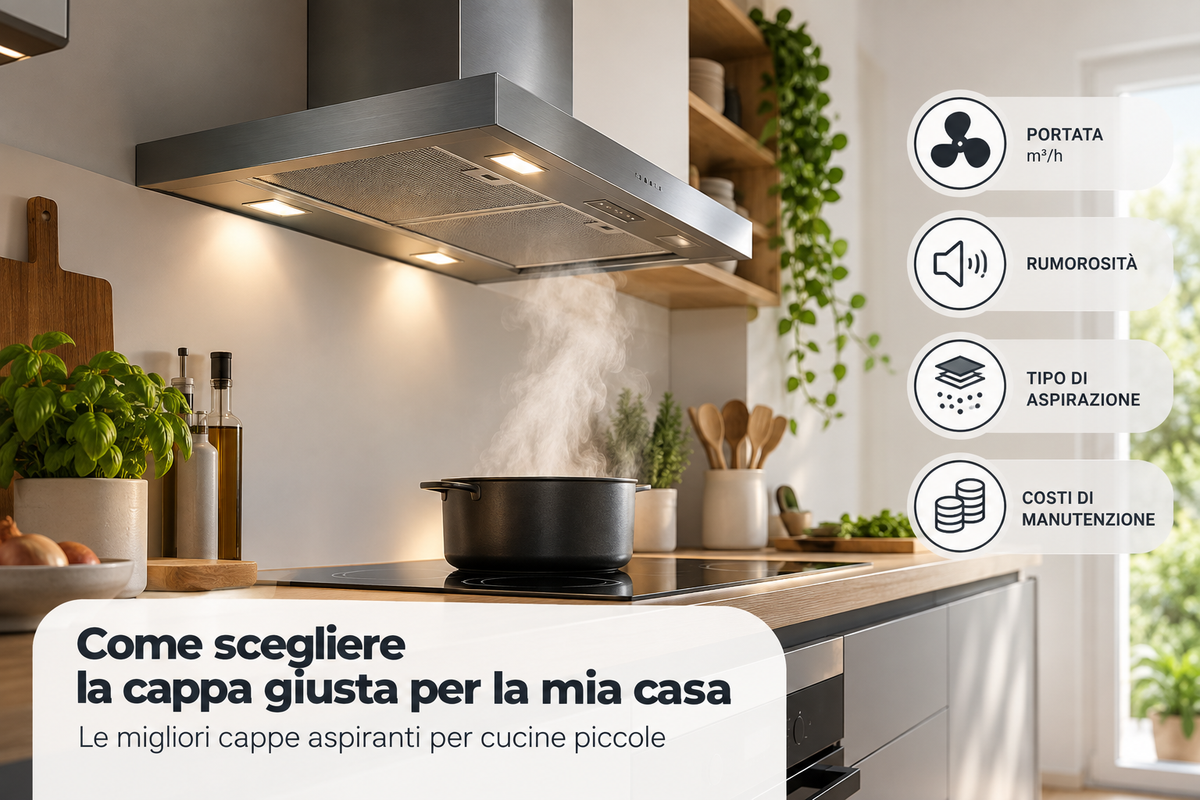
Choosing an extractor hood does not simply mean finding a model with the right dimensions for the cooktop. The real question is: how much air the hood needs to extract to effectively eliminate smoke, steam, and odours without consuming too much energy, making excessive noise, or requiring costly maintenance?
For a small kitchen, the choice becomes even more important. A small space can quickly become saturated with steam and odours, but an oversized hood is not necessarily the best solution.
The right choice depends mainly on kitchen volume, extraction airflow, installation method, duct length, frequency of use, and maintenance costs.
In summary: which hood should you choose for a small kitchen?
For a small kitchen, it is generally advisable to choose a hood with airflow appropriate for the room's volume, avoiding choosing solely on the basis of the maximum stated m³/h.
As a practical reference:
-
very small kitchen: approximately 250-350 m³/h may be sufficient in many situations;
-
small/medium-sized kitchen: approximately 350-500 m³/h;
-
larger kitchen or open-plan space: higher airflow rates are generally required;
-
kitchens with high levels of steam and smoke: greater extraction capacity may be useful, especially if the duct has pressure losses.
These values are indicative: the airflow actually required must be assessed by considering the room's volume and the air evacuation system.

How to calculate the extractor hood's airflow
The first parameter to consider is the kitchen volume.
The formula is simple:
Kitchen volume = length × width × height
For example, a kitchen that is:
-
3 metres long
-
2.5 metres wide
-
2.7 metres high
has a volume of:
3 × 2.5 × 2.7 = 20.25 m³
For a domestic kitchen, an air exchange rate of approximately 10-12 times the room's volume per hour, taking the installation characteristics into account.
In our example:
20.25 × 10 = approximately 200 m³/h
or:
20.25 × 12 = approximately 243 m³/h
This calculation is a starting point. In reality, the hood's capacity must also be assessed by considering filters, bends, duct length and diameter, and the exhaust method.
Why isn't the stated airflow everything?
A hood listed as "500 m³/h" does not necessarily mean that it can move 500 m³/h of air during actual use.
Performance can decrease significantly when the air has to pass through:
-
filters;
-
long pipes;
-
bends;
-
diameter reductions;
-
undersized ducts;
-
grilles or terminals with high resistance.
For this reason, when comparing two hoods, it is important not to stop at the maximum rated airflow, but to consider the actual performance at different speeds.
How many m³/h should a hood have for a small kitchen?
There is no single value that is valid for all kitchens.
A 15 m³ kitchen and a 30 m³ kitchen require different amounts of air.
A guide table could be as follows:
| Kitchen volume | Indicative airflow |
|---|---|
| 10 m³ | 150-250 m³/h |
| 15 m³ | 200-300 m³/h |
| 20 m³ | 250-350 m³/h |
| 25 m³ | 300-450 m³/h |
| 30 m³ | 350-500 m³/h |
| 40 m³ | 450-600 m³/h |
The figures are indicative and do not replace verification of the extraction system.
In a small kitchen, moreover, it is not always advantageous to choose the hood with the highest available airflow.
Excessive airflow can mean:
-
more noise;
-
higher electricity consumption;
-
higher air velocity;
-
greater need to replace the extracted air;
-
possible inefficiency if the duct is not correctly sized.
Extractor hood for a small kitchen: more powerful or quieter?
The correct answer is: neither necessarily the most powerful nor necessarily the quietest.
The best hood is the one that achieves good extraction with the least possible noise.
This is particularly important in a small kitchen, where the distance between the hood and people is limited.
It is therefore useful to have at least three levels:
1. Minimum airflow
It is suitable for light activities, such as boiling water or preparing foods that produce little steam.
2. Medium airflow
This is normally the most frequently used level in everyday cooking.
3. Maximum airflow
It is needed when more fumes and steam are produced, for example during frying, high-temperature cooking, or particularly intense preparation.
A good hood should therefore allow you to adjust the extraction, rather than always operating at maximum speed.
How large should a hood be compared with the cooktop?
The hood's width is another important factor.
As a general principle, the hood should be at least as wide as the cooktop, while a slightly greater width can improve the ability to capture steam and fumes.
For example:
-
60 cm cooktop → hood at least 60 cm wide;
-
70-75 cm cooktop → it is better to consider a wider hood;
-
80-90 cm cooktop → it is advisable to choose a correspondingly sized hood.
However, width cannot compensate for insufficient airflow.
A very wide but underperforming hood might extract air less effectively than a more compact, correctly sized hood.
Filtering or extractor hood: which should you choose?
This is one of the most important decisions.
Extractor hood
The extractor hood draws air from the kitchen and expels it outdoors through a duct.
It is generally the most effective solution for eliminating:
-
steam;
-
odors;
-
grease particles;
-
combustion products, where applicable.
However, performance depends greatly on the quality of the installation.
A short, correctly sized duct with few bends allows the hood to work better.
Filtering hood
The filtering hood does not expel air outdoors.
The air is instead filtered and returned to the room.
In this case, the filters become essential, especially those intended to absorb odors.
A recirculating solution can be useful when it is not possible to install a duct to the outside, but it requires more careful maintenance.
How much does it cost to maintain an extractor hood?
Maintenance costs mainly depend on the type of filter and frequency of use.
Routine maintenance mainly includes:
-
cleaning of metal filters;
-
replacement of odor filters, when present;
-
cleaning of internal surfaces;
-
duct inspection;
-
any professional cleaning in cases of intensive use.
Grease filters
Metal filters can normally be cleaned periodically.
Regular cleaning is important because grease buildup:
-
reduces efficiency;
-
increases the load on the motor;
-
may increase noise;
-
worsens hygiene;
-
increases the risk associated with the accumulation of flammable substances.
Charcoal filters
Recirculating range hoods generally contain filters designed to reduce odors.
These filters have a limited lifespan and must be replaced according to the manufacturer's instructions and depending on usage.
The operating cost of a recirculating range hood may therefore be higher than that of a properly installed extractor hood because it requires periodic replacement of the odor filters.
How much does range hood maintenance cost?
To assess the actual cost of a range hood, you should not consider only the purchase price.
It is useful to calculate the total operating cost:
Total cost = purchase + filters + energy + any maintenance + any work on the extraction system
An inexpensive range hood that frequently requires replacement filters may, in the long term, cost more than a model that is initially more expensive but requires less maintenance.
Before buying, it is therefore worth checking:
-
filter prices;
-
replacement frequency;
-
availability of spare parts;
-
cost of the odor filter;
-
accessibility of the components;
-
ease of cleaning.
How much electricity does an extractor hood use?
A range hood's electricity consumption mainly depends on the motor's power and the time it is used.
In a home kitchen, the range hood is not normally left on for many consecutive hours. For this reason, in most cases, the motor's energy consumption is not the main operating cost.
It is still preferable to use the speed required for the cooking in progress, avoiding keeping the extraction at maximum continuously.
The real cost difference may be determined more by maintenance and filters than the motor's electricity consumption.
How to choose a range hood for a small kitchen
Before buying a range hood, check these seven parameters:
1. Kitchen volume
Calculate length × width × height.
2. Airflow
Compare the m³/h with the volume of the room.
3. Extraction type
Check whether you can exhaust the air outside or whether you need to use a filtering configuration.
4. Size
The width should be suitable for the cooktop.
5. Duct
Diameter, length, and number of bends have a tangible effect on performance.
6. Noise level
Check the noise level at different speeds, not only at the minimum speed.
7. Maintenance costs
Before purchasing, check the price and lifespan of the filters and the availability of replacement parts.
The best extractor hoods for small kitchens: how to choose them
The "best" hood for a small kitchen is not necessarily the one with the highest number of m³/h.
The choice should follow this logic:
small kitchen + efficient duct → adequate airflow and good quietness
small kitchen + many bends in the duct → greater attention to pressure losses
small kitchen without an external outlet → filtering solution and assessment of filter costs
small open-plan kitchen → greater attention to airflow, noise, and capture capacity
In other words, the hood must be sized according to the room and the installation, not chosen solely on the basis of the stated maximum power.
FAQ: frequently asked questions about choosing a hood
How many m³/h should a hood have for a small kitchen?
It depends on the kitchen's volume and the installation. As an initial reference, a kitchen of approximately 20-25 m³ may require a hood rated around 250-450 m³/h, to be assessed considering the duct, filters, and extraction mode.
Does a more powerful hood always extract better?
No. Maximum airflow is not enough to determine extraction quality. The duct, diameter, bends, filters, and hood design also affect actual performance.
Is an extractor hood or a filtering hood better?
When an external exhaust duct can be installed correctly, an extractor hood removes kitchen air instead of filtering it and recirculating it indoors. A filtering solution is an alternative when external exhaust is not possible, but it requires more attention to filter maintenance.
How often should the hood filter be cleaned?
The frequency depends on how intensively the hood is used and on the type of cooking. Cooking methods that produce a lot of grease require more frequent cleaning. The filter must still be kept clean to prevent reduced performance.
How long do charcoal filters last?
Lifespan varies depending on the type of filter and usage. To determine the correct replacement interval, follow the manufacturer's specific instructions.
Is a large hood better for a small kitchen?
Not necessarily. A hood should be proportionate to the cooktop, the room's volume, and the extraction system. An oversized hood may be ineffective if the duct does not allow its capacity to be used properly.


Leave a comment
This site is protected by hCaptcha and the hCaptcha Privacy Policy and Terms of Service apply.