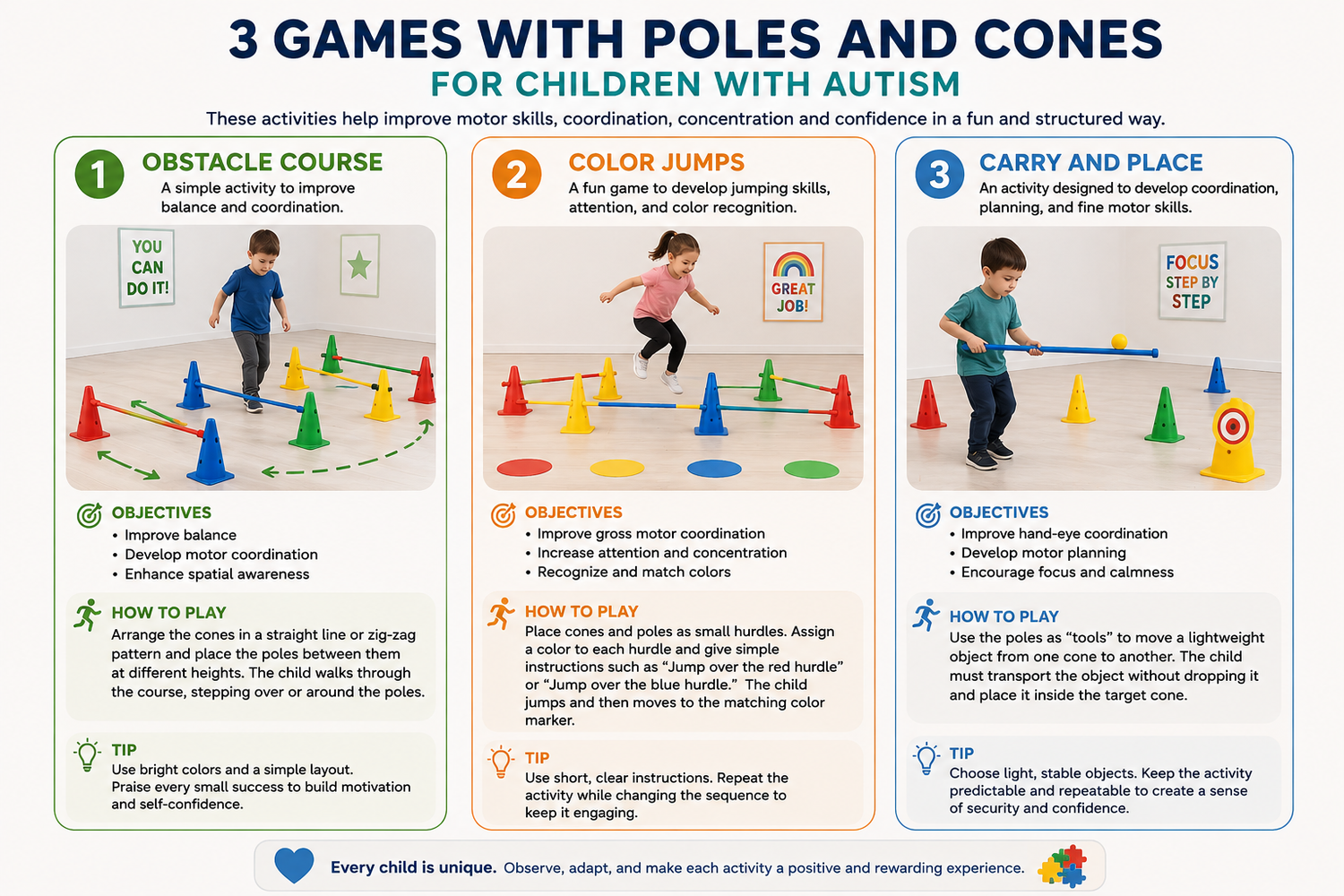
Why psychomotor games are useful for autistic children
Psychomotor games for autistic children are a valuable tool to promote motor, cognitive, and relational development. Through movement, the child can improve body awareness, develop coordination skills, and gain greater confidence in daily activities.
Many children with autism spectrum disorder benefit from activities involving balance, spatial orientation, and sensory stimulation. Psychomotor paths allow working on these skills naturally and enjoyably, respecting individual timing and needs.
Benefits of psychomotor games for autistic children
Psychomotor activities can help to:
-
Improve balance and motor coordination.
-
Promote body awareness.
-
Stimulate attention and concentration.
-
Reduce stress and sensory overload.
-
Increase autonomy and self-esteem.
-
Support the development of social skills through shared play.
Every child is unique, but movement often represents a privileged channel for learning new skills and strengthening those already acquired.
Which psychomotor games to choose
Balance paths
Walking on low beams, platforms, or marked paths on the ground helps the child develop motor control and spatial awareness.
Soft modules and obstacles
Overcoming small obstacles, climbing up and down safe structures promotes coordination, movement planning, and confidence in one's abilities.
Throwing and precision games
Throwing balls at targets or containers improves hand-eye coordination and concentration.
Sensory activities
Paths made with different surfaces stimulate the sensory system through controlled and gradual experiences.
Structured movement games
Activities involving simple and repetitive sequences can be particularly effective for many autistic children, thanks to the predictability and clarity of the rules.
🔎 Download 6 psychomotor games to play at home
How to create a psychomotor path at home
Even without professional equipment, it is possible to carry out effective activities using:
-
Cushions to create obstacles.
-
Colored tape to mark paths.
-
Hoops or ropes for jumping exercises.
-
Tunnels made with chairs and blankets.
-
Soft balls for coordination exercises.
It is important to propose gradual activities, avoiding excessive stimulation that could cause discomfort or fatigue.
Wooden psychomotor games: an educational and sustainable choice
Wooden psychomotor games are particularly appreciated by families, educators, and therapists because they offer stability, durability over time, and a natural sensory experience.
Among Italian companies specialized in the field, Italveneta Didattica stands out, developing psychomotor programs, educational equipment, and movement modules used in schools, educational centers, and home settings. The solutions are designed to support the development of motor skills and promote learning through direct experience.
How to choose the best psychomotor games for autistic children
It is important to consider the following when choosing:
-
Child's age.
-
Level of motor development.
-
Individual sensory sensitivity.
-
Material safety.
-
Ability to adapt the game over time.
The most effective products are those that allow for a gradual increase in the complexity of activities, accompanying the child's growth.
🔎 Discover the choices made by Rustilia in collaboration with the leading brand in Italy
Do psychomotor games help autistic children?
Yes. They can promote the development of coordination, balance, autonomy, and body awareness.
What are the best psychomotor games for autistic children?
Balance courses, sensory activities, precision games, and movement modules are among the most commonly used solutions.
At what age can they be introduced?
Psychomotor activities can be adapted from early childhood and accompany the child throughout their development.
Conclusion
Psychomotor games for autistic children provide valuable support for the development of motor, sensory, and social skills. Through structured programs, balance activities, and coordination games, it is possible to offer the child engaging learning opportunities that respect their individual characteristics. Choosing quality tools, such as those offered by Italveneta Didattica, allows for the creation of safe, stimulating play environments that can support growth over time.




Leave a comment
All comments are moderated before being published.
This site is protected by hCaptcha and the hCaptcha Privacy Policy and Terms of Service apply.