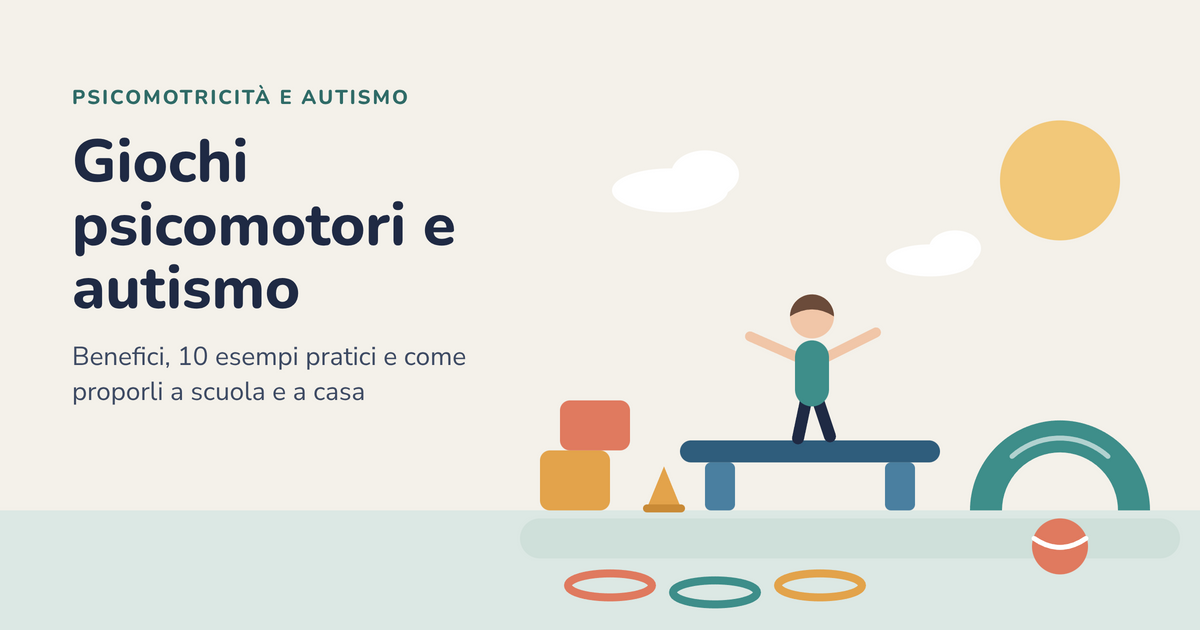
Yes. Psychomotor games are structured, playful movement activities that develop coordination, balance, and body awareness. Research indicates that for children with autism spectrum disorder (ASD), they can benefit motor skills, social interaction, and behavior, especially when the activities are regular, predictable, and tailored to each child.
Running, jumping, throwing a ball, or balancing on a beam may seem like simple actions. For many autistic children, they are not. Motor difficulties are common, but often take a back seat to language and behavior.
This article covers what the research says, 10 psychomotor games grouped by goal, and practical tips for introducing them at school, in the gym, and at home.
What are psychomotor games, and why do they matter in autism?
Psychomotor games are playful activities that bring together movement, perception, and emotion. Children learn through their bodies: rolling, jumping, climbing, throwing, and stopping at a signal. Play is not a reward after therapy; it is the tool used in the work.
Autism spectrum disorder is a neurodevelopmental condition that affects social communication and involves restricted interests and repetitive behaviors. In Italy, about 1 in 77 children aged 7 to 9 has an ASD diagnosis, with 4.4 boys diagnosed for every girl (Ministry of Health, data from the ISS National Autism Observatory). Worldwide, the WHO estimates about 1 in 100 children.
Motor difficulties are not part of the diagnostic criteria, but they are very common:
- 35,4% of children under 6 with autism have significant motor difficulties, nearly as many as have intellectual disability (37.7%). Motor difficulties had been reported at diagnosis in only 1.34% of cases (Licari et al., Autism Research 2020, 2,084 children).
- 87% of children aged 5 to 15 are at risk of motor delays, but only about 30% receive physical therapy (SPARK study, Bhat 2020, nearly 12,000 participants).
Balance, coordination, and movement planning also affect social life. Pointing to an object, looking at the person speaking, playing chase with classmates: these are all motor actions. That’s why psychomotor activities can also be a gateway to relationships.
What benefits do psychomotor games have for autistic children?
The broadest scientific reviews indicate a moderate positive effect of structured physical activity. A meta-analysis of 29 studies and 1,009 children and adolescents found a moderate overall effect (g = 0.62), most pronounced in object manipulation, locomotion, physical fitness, and social functioning (Healy et al., Autism Research 2018). A 2025 meta-analysis of 23 randomized studies confirms improvements in coordination, social skills, cognitive control, and behavior, with better results for martial arts and ball games (Wang et al., Frontiers in Pediatrics).
The main benefits, in brief:
- Motor skills: running, jumping, throwing, and catching improve with regular programs lasting several weeks.
- Coordination and balance: the child moves with greater confidence and falls less often.
- Social interaction: in preschool-age children, the effect on social skills was significant; partner and group games train turn-taking, imitation, and shared attention.
- Self-regulation and behavior: movement helps release tension and can reduce problem behaviors.
- Executive functions: stopping at a signal, changing a rule, and planning a route train flexibility and self-control.
A limitation to keep in mind. Results vary widely across studies, ages, and types of activity, and not all reviews find significant effects in every area. Psychomotor games complement the interventions recommended by the ISS guidelines for treating ASD in children and adolescents; they do not replace them. The program should be developed with a child neuropsychiatrist and a developmental neuropsychomotor therapist (TNPEE).

What psychomotor games can you play with an autistic child?
The best games start with a specific goal and the child’s interests. Here are 10 ideas, divided by area.
Coordination and balance
- Motor skills circuit with stations. A tunnel, hoops, a low beam, and blocks to step over, always in the same order. The fixed sequence makes the game predictable; pictures on the ground indicate the next station.
- The bridge over the river. The child crosses a beam or a row of soft building blocks without “falling into the water.” Make it harder by raising the beam or asking the child to carry an object.
- Jump through the hoops. Colored hoops are placed on the ground: the child jumps with feet together, following a color or number. This trains balance, rhythm, and attention.
Sensory integration and regulation
- The sandwich. The child lies between two soft mats while the adult applies light, steady pressure. Deep pressure is often calming; use it only if the child accepts and seeks it out.
- Roll down a wedge. Roll down a soft incline to work on body awareness and the vestibular system.
- Sensory treasure hunt. Hide objects in a ball pit or on a tactile mat. Start with surfaces the child likes and gradually introduce new ones.
Relationship and communication
- Throw and catch. Toss a soft ball between the adult and child, then between two children. Before throwing, say the other person's name or make eye contact: it's an exercise in joint attention.
- The mirror. L'adult imitates the child's movements, then they switch roles. Imitating and being imitated is one of the foundations of reciprocity.
- The colorful parachute. As a group, raise and lower the sheet together, then take turns going underneath when you hear your name. It also works well with classmates at school.
Control and executive functions
- Musical statues. Move to the music and freeze when it stops. You can add a visual rule (red card = stop) for children who struggle with auditory stimuli.
How to introduce psychomotor games: 7 practical tips
Success depends more on "how" than on "what." These tips apply at school, in the gym and at home.
- Make everything predictable. Keep the same sequence, space and materials. A visual schedule with pictures of the activities reduces anxiety about change.
- Reduce stimuli. Keep lighting moderate, noise low and materials tidy. A chaotic environment can overwhelm the child before they even begin.
- Start with their interests. If they love trains, turn the course into a railway. Motivation is the driving force behind learning.
- One step at a time. Break each game into short stages and add difficulty only when the previous stage feels safe.
- Give short, visual instructions. Show the movement instead of explaining it; use arrows, footprints and colors on the floor.
- Respect the sensory profile. Some children seek strong stimuli, while others avoid them. Observe their reactions and adjust pressure, speed and contact.
- Consistency matters more than duration. Short, regular sessions (15-30 minutes, several times a week) are more useful than an occasional hour-long session. Programs studied in research generally last several weeks.
Who does what
- Therapist (TNPEE) or psychomotor therapist: assesses the motor and sensory profile, and sets goals and progressions.
- Teacher and special education teacher: incorporate the games into classroom physical education, involving classmates.
- Parents: repeat 2-3 familiar games at home so the child can generalize what they learn.
What materials do you need?
To get started, you only need a few soft, safe items: mats, hoops, cones, foam blocks and beams, a tunnel, balls of different textures, and a play parachute. Covered foam materials are suitable because they cushion falls, are easy to clean, and can be rearranged into ever-changing courses.
Summary table: games, goals, and materials
|
Game |
Main goal |
Materials |
Individual or group |
|---|---|---|---|
|
Station course |
Coordination, motor planning |
Tunnel, hoops, balance beam, soft blocks |
Both |
|
The bridge over the river |
Balance |
Low balance beam or foam blocks |
Individual |
|
Jump into the hoops |
Balance, rhythm, attention |
Colored hoops |
Both |
|
The sandwich |
Sensory regulation |
2 soft mats |
Individual |
|
Roll down the wedge |
Body awareness, vestibular system |
Soft wedge |
Individual |
|
Sensory treasure hunt |
Tactile integration |
Ball pit, tactile mats |
Individual |
|
Throw and catch |
Joint attention, grasping |
Soft ball |
Pair |
|
The Mirror |
Imitation, reciprocity |
None |
Pair |
|
Colored parachute |
Cooperation, waiting for a turn |
Play parachute |
Group |
|
Musical statues |
Inhibitory control |
Music, colored cards |
Group |
Frequently asked questions
At what age can children start psychomotor activities?
As early as 2-3 years old, soon after diagnosis or even while undergoing assessment. The earlier you start, the more you can benefit from developmental plasticity. Activities can then be adapted for primary school and adolescence.
Is psychomotor therapy a treatment for autism?
Neuro- and psychomotor therapy is a rehabilitation intervention provided by a TNPEE as part of an individualized plan. It is not a cure: autism cannot be “cured.” However, alongside other interventions recommended by the neuropsychiatrist, it helps develop motor, sensory, and social skills.
How often should you do psychomotor activities?
Short and frequent is best: 15-30 minute sessions several times a week for several weeks. Consistency matters more than the length of any single session.
Can you do them at home?
Yes, with simple games the child has already tried with their therapist. All you need is a clear space, a few mats, and a consistent routine. Practicing at home helps the child apply their skills in everyday life.
Which sports are suitable for children with autism?
Research shows good results with martial arts, ball games, swimming, and horseback riding. The best sport is one the child enjoys, with clear rules and a well-trained instructor.
What should I do if my child refuses to play?
Don't force it. Reduce stimulation, return to an activity the child already enjoys, and introduce the new game in small steps. Refusal often signals sensory overload or a change that happened too quickly.

Leave a comment
All comments are moderated before being published.
This site is protected by hCaptcha and the hCaptcha Privacy Policy and Terms of Service apply.