The wireless self-cleaning litter box is an innovative solution for anyone who wants to keep their home clean, reduce the daily work of dealing with cat waste, and improve home hygiene. But how much electricity does an automatic litter box use? Is it really safe for cats? And what features should you consider before buying?
In this guide, we’ll explore how self-cleaning litter boxes work, how much electricity they use, which safety systems to check, and how to choose the model best suited to your pet’s needs.
How much electricity does a self-cleaning litter box use?
A self-cleaning litter box generally uses little electricity, because the motor only runs during cleaning cycles, while the sensors and control electronics may remain on standby.
Actual consumption depends on the motor’s power, the frequency of cleaning cycles, standby time, and built-in features such as Wi-Fi connectivity or app monitoring.
To understand the impact on your electricity bill, it’s important to distinguish between rated power and actual energy consumption.
Practical example of electricity consumption
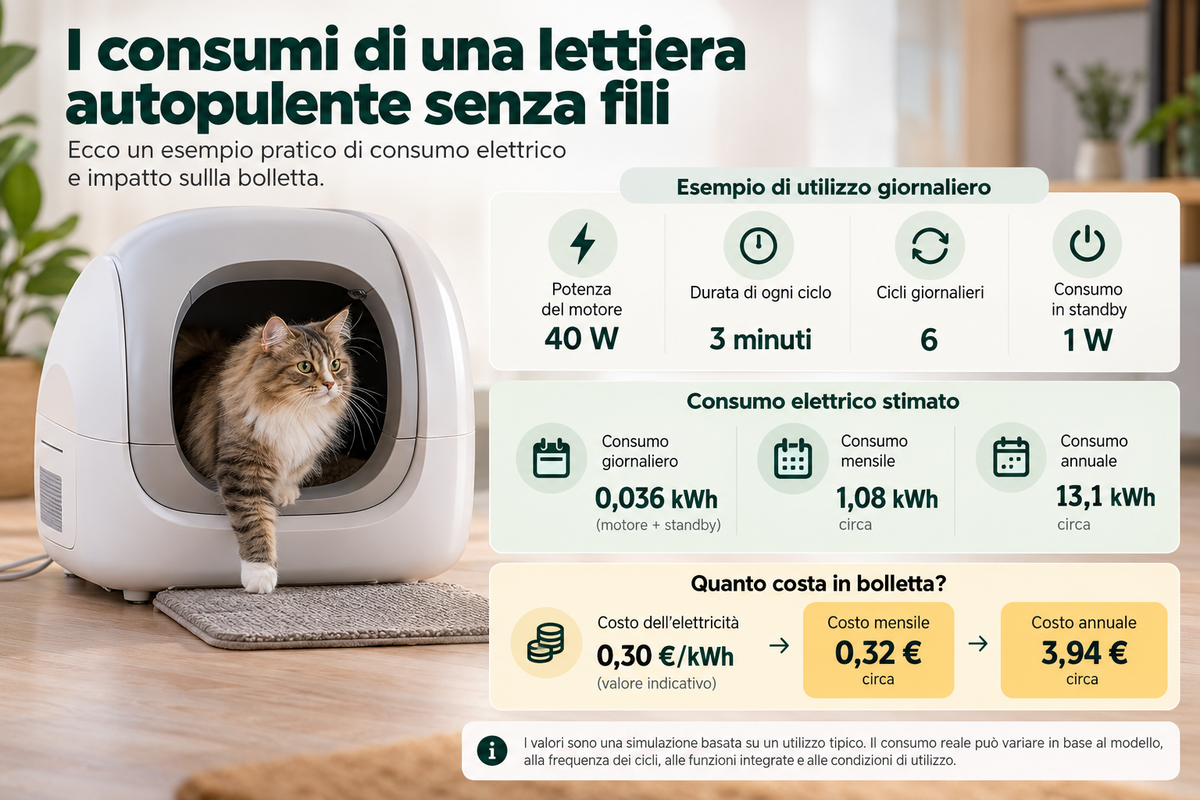
Let’s consider a litter box with a 40 W motor, used for 3 minutes per cycle, with 6 cleaning cycles a day and standby consumption of 1 W.
| Consumption item | Estimated value |
|---|---|
| Motor power | 40 W |
| Duration of each cycle | 3 minutes |
| Cycles per day | 6 |
| Daily motor consumption | 0.012 kWh |
| Daily standby consumption | 0.024 kWh |
| Total monthly consumption | About 1.08 kWh |
| Annual consumption | About 13.1 kWh |
At an estimated electricity cost of €0.30/kWh, the consumption in this example comes to about €0.32 per month, or about €3.94 per year.
These figures are an estimate, not a universal measurement: actual consumption must be verified based on the product’s technical specifications and conditions of use. A device with a more power-hungry standby system or longer cycles may consume more.
How do you calculate the cost of a self-cleaning litter box?
The formula is simple:
Monthly consumption in kWh × electricity cost per kWh = monthly cost.
For example, with a consumption of 2 kWh per month and a rate of €0.30/kWh, the cost will be €0.60 per month.

Wireless self-cleaning litter box: what does it really mean?
The expression wireless This can refer to two different features, which are important not to confuse before making a purchase.
-
No permanent connection to an electrical outlet: The device runs on a rechargeable battery or an independent power system. In this case, battery life depends on the battery’s capacity and the frequency of the cycles.
-
Wireless control: The litter box can use a wireless connection to communicate with an app, but still requires an electrical connection to operate.
If you want to place the litter box somewhere in your home without a nearby outlet, make sure the model is battery-powered and can complete automatic cycles without being connected to the electrical grid.
If you're looking for a smart solution instead, check for wireless connectivity, maintenance notifications, and activity monitoring.
Is a self-cleaning litter box safe for cats?
A self-cleaning litter box can be safe when properly designed, used according to the instructions, and equipped with adequate safety systems. However, safety doesn't depend solely on automation: what matters most is how the device detects the animal's presence and controls the movement of its mechanical parts.
Check for these features before purchasing.
1. Presence and weight sensors
The sensors must detect the cat's presence and prevent the cleaning cycle from starting while the animal is still inside or in the movement area.
It's important to check how the sensors work, under what conditions they stop the cycle, and whether the manufacturer specifies usage limitations for kittens or smaller animals.
2. Automatic stop when an obstacle is detected
An effective safety system must stop or prevent movement when it detects a potentially dangerous condition.
It's not enough for the litter box to be automatic: check for safeguards against accidental activation and movement while the animal is present.
3. Controlled restart
After a power interruption, the device should restart safely, avoiding unexpected movements when the cat approaches or enters the litter box.
Restart methods vary from model to model and should be described in the technical documentation.
4. Stability and protection of moving parts
A stable structure reduces the risk of tipping or shifting during operation. Moving parts should also be designed to limit the risk of entrapment.
5. Power supply and electrical components
Check applicable compliance requirements, the quality of the power supply, and the instructions for use in household environments. Having a battery does not, by itself, guarantee a higher level of safety.
Practical tip: During the first few uses, observe your cat's behavior and don't force it to enter the litter box. For kittens, senior cats, or pets with mobility issues, carefully check the weight limits, entrance dimensions, and manufacturer's instructions.
What are the benefits of a self-cleaning litter box?
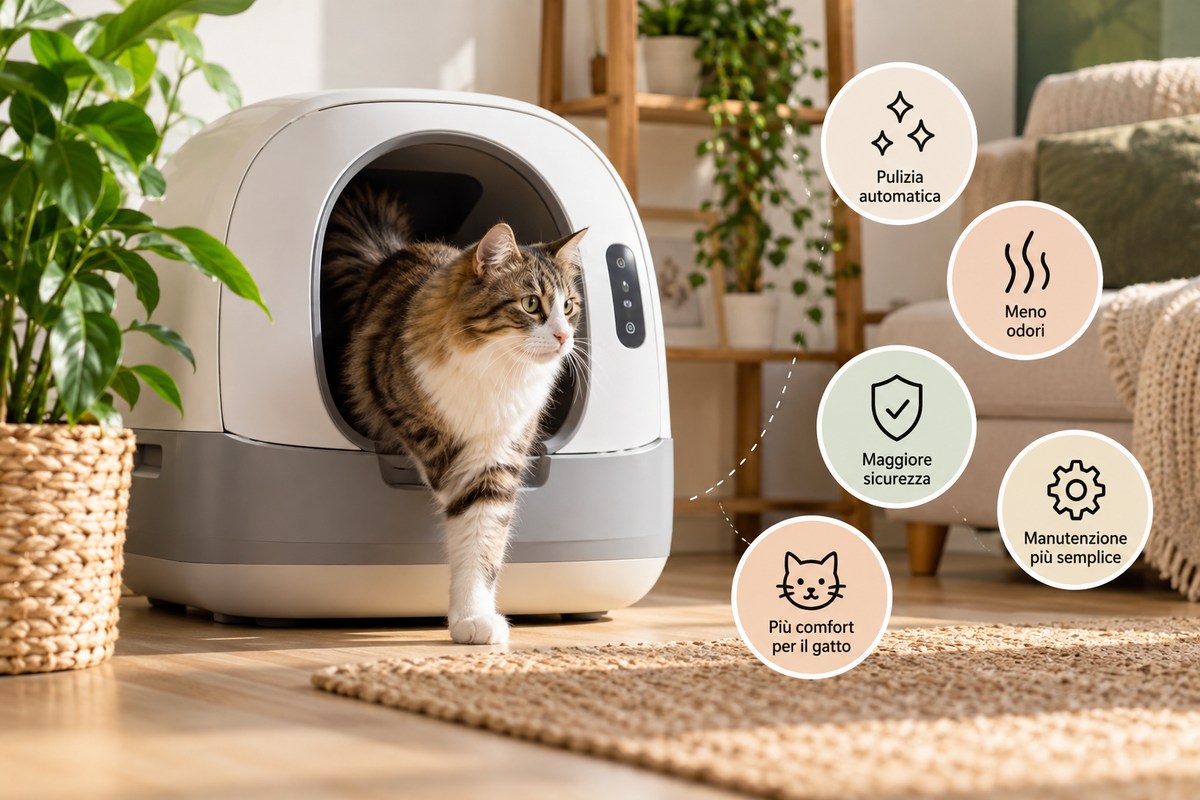
Choosing an automatic litter box means making daily cleaning easier, with benefits that can vary depending on the model and your cat's habits.
Less manual cleaning. The system automatically separates waste from clean litter, reducing the need to scoop up waste after each use.
More consistent hygiene. Automatic cycles help keep the tray tidier, provided the waste container is emptied regularly.
Odor control. Containment systems and filters, if included, can help limit odor spread. Results also depend on the quality of the litter and how often the unit is maintained.
Greater flexibility in placement. Models that run on batteries allow you to choose a location with fewer restrictions related to electrical outlets.
Possible smart features. Some devices let you receive notifications about waste levels, check the litter box's status, or view usage information.
It's important to remember that a self-cleaning litter box doesn't eliminate maintenance: the waste container, interior surfaces, and any filters need to be cleaned or replaced according to the manufacturer's instructions.
How to choose a cordless self-cleaning litter box
Before buying an automatic litter box, compare the features that genuinely affect everyday convenience.
| Feature | What to check |
|---|---|
| Power supply | Rechargeable battery or continuous power supply |
| Operating life | Declared number of cycles and conditions of use |
| Electricity consumption | Power, standby consumption, and available energy data |
| Safety | Presence sensors, obstacle detection, and automatic stop |
| Size | Interior space, entrance, and compatibility with your cat's size |
| Odor control | Closed container, seals, and any filters |
| Maintenance | How easy it is to disassemble and clean parts that come into contact with waste |
| Smart features | Notifications, monitoring, and connectivity, if desired |
| Support | Warranty, spare parts, and technical support availability |
Don't choose based solely on price or the number of electronic features. Above all, a good automatic litter box should be reliable, easy to clean, and suited to your cat's size and habits.
Self-cleaning litter box: is it really worth it?
For anyone looking for greater convenience in daily cat care, a self-cleaning litter box can be an appealing investment.
The most obvious financial benefit is not necessarily energy savings, since electricity consumption may already be very low: the main benefit is spending less time on manual cleaning and managing waste more consistently.
When assessing the total cost, also consider the initial price, any dedicated bags, filters, compatible litter, maintenance, and replacement of wear parts.
To make an informed choice, compare the purchase price with the expected running costs and check that the cleaning system is compatible with the type of litter you prefer to use.
Buy a self-cleaning litter box suited to your cat's needs
Want to spend less time cleaning and make daily litter box care more convenient?
At Rustilia, you can explore pet care solutions by considering power supply, safety, ease of maintenance, and available features.
Before buying, check the technical specifications, stated battery life, safety features, and the cost of consumables. This will help you find a solution that suits your available space at home and your cat's needs.
Discover pet care solutions at Rustilia and enjoy convenience without compromising on safety.
Frequently asked questions about cordless self-cleaning litter boxes
How much power does a self-cleaning litter box use per month?
Power consumption depends on the motor, cleaning cycles, and standby mode. In a simulation with a 40 W motor, six daily cycles of three minutes each, and 1 W standby power, consumption is about 1.08 kWh per month.
Does a cordless self-cleaning litter box work without electricity?
Only if it has an independent power supply, such as a rechargeable battery. The term wireless may refer exclusively to a connection with an app and does not guarantee operation without an electrical outlet.
Are self-cleaning litter boxes dangerous for cats?
Not necessarily. It's important to choose a model with presence sensors, stop mechanisms, and suitable safety features. You should also follow the weight limits and instructions for use, paying particular attention to kittens and animals with limited mobility.
Does a self-cleaning litter box completely eliminate bad odors?
No. It can reduce odors by automatically removing waste and using any available containment systems, but maintaining the container, cleaning surfaces, and replacing filters are still necessary.
How often should an automatic litter box be cleaned?
It depends on the number of cats, the container capacity, and the manufacturer's instructions. You should check the waste container frequently and schedule regular cleaning of the internal parts.
What is the best cordless self-cleaning litter box?
The best choice is one that combines a power supply suited to your needs, documented safety systems, a size compatible with your cat, simple maintenance, and affordable running costs. There is no single model that is universally best for all pets and homes.

Leave a comment
All comments are moderated before being published.
This site is protected by hCaptcha and the hCaptcha Privacy Policy and Terms of Service apply.