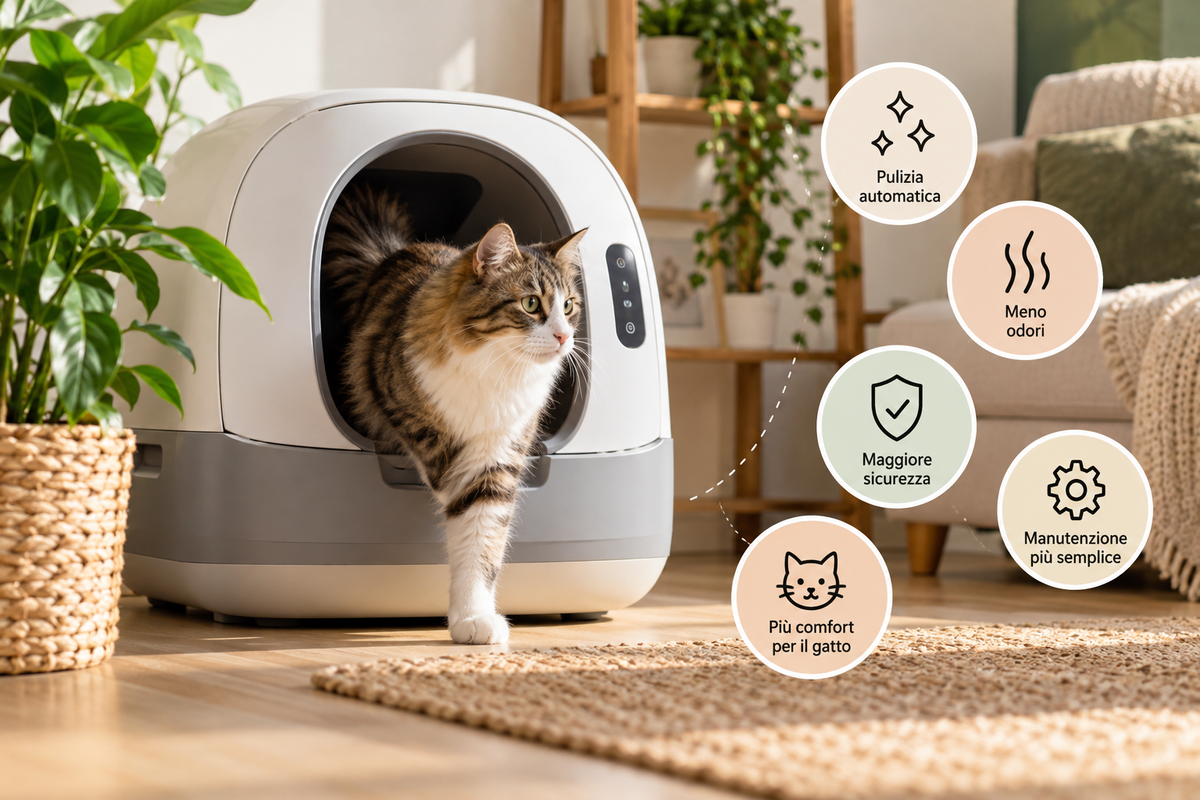
Choosing a self-cleaning litter box for cats means improving household hygiene, reducing the time spent on daily cleaning, and providing your cat with an increasingly comfortable environment. But which automatic litter boxes really work? The difference depends not only on the level of automation: the quality of the cleaning system, odor management, sensor safety, and ease of maintenance determine long-term effectiveness.
The best self-cleaning litter boxes reliably remove waste, limit the spread of odors, adapt to the cat's habits, and make waste management easy. Before purchasing, it is therefore important to evaluate the technical features and your pet's behavior.
How does a self-cleaning litter box for cats work?
A self-cleaning litter box is a device designed to automatically separate waste from clean litter, collecting it in a dedicated container. Depending on the model, cleaning may take place through a rotating mechanism, an automatic rake, or a washing and drying system.
In the most common automatic versions, the cleaning cycle starts after the cat has used the litter box and left the usage area. Sensors detect the animal's presence and allow the device to start the cycle only when conditions are considered safe.
The result is a litter box that requires less manual intervention, while still requiring the container to be emptied, litter to be replenished, and the internal parts to be cleaned periodically.
Which self-cleaning litter boxes work best?
There is no single ideal system for all cats. Effectiveness depends on the cleaning mechanism, the type of compatible litter, the device's size, and the animal's habits.
1. Self-cleaning litter box with a rotating system
This type uses a drum or rotating chamber that separates clumps and waste from reusable litter. During the cycle, the waste is directed into a collection container.
It is suitable for: those looking for an automatic system to reduce daily cleaning.
Features to consider:
-
Effective separation of clumps from clean litter.
-
Presence sensors and safety shut-off systems.
-
Easily removable waste container.
-
Simple structure to disassemble and wash.
-
Internal dimensions suitable for the cat's body size.
2. Self-cleaning litter box with automatic rake
The system uses a motorized rake that moves through the litter and collects waste in a dedicated compartment. It is a mechanically simple solution, but performance depends on the quality of the rake and its compatibility with the litter used.
It is suitable for: those who want a basic device that is relatively simple to manage.
Before purchasing, it is important to check that the rake does not leave residue in the corners, does not jam easily, and is compatible with the type of litter specified by the manufacturer.
3. Self-cleaning litter box with app control
Some automatic litter boxes integrate Wi-Fi connectivity and a smartphone app. These features can allow you to monitor cleaning cycles, receive notifications when the container is full, and check the device's status.
It is suitable for: those who want to manage the litter box even when they are away from home.
Smart features are genuinely useful when they simplify maintenance. It is preferable to choose a device that guarantees reliable cleaning even without an Internet connection or constant app use.
4. Self-cleaning litter box with automatic washing system
There are also solutions that use washing and drying systems, generally designed to work with specific materials and dedicated maintenance procedures.
It is suitable for: those looking for a higher level of automation and willing to manage installation, consumables, and maintenance.
Before choosing this type, you need to check the water connection requirements, drainage, consumption, compatibility with the cat, and the operations required to keep the device hygienic.


The features that make a self-cleaning litter box effective
To understand which self-cleaning litter boxes really work, it is useful to focus on the features that have a tangible impact on daily use.
| Feature | Why it matters |
|---|---|
| Reliable presence sensors | They prevent the cycle from starting while the cat is inside or nearby, depending on the safety system used. |
| Adjustable automatic cleaning | It allows the operation to be adapted to usage times and the animal's needs. |
| Large-capacity waste container | It reduces the frequency of emptying. |
| Odor containment system | It helps limit the spread of odors, especially if the container is well sealed and emptied regularly. |
| Litter compatibility | It prevents problems with clump separation and material buildup in the mechanism. |
| Easy to disassemble | It allows access to the internal parts and removal of residue. |
| Low noise level | It can make the device easier for more sensitive cats to accept. |
| Adequate size | They promote a natural posture and allow the cat to enter, turn around, and exit comfortably. |
| Replacement parts available | They help keep the device efficient over the long term. |
A litter box packed with features is not necessarily the most effective. In many cases, a good safety system, reliable waste separation, and easy maintenance are more important than the number of digital features.
Self-cleaning litter box for cats: what advantages does it offer?
The main advantage is the reduction of manual intervention. Automatic waste collection helps keep the litter cleaner between uses and can make daily management easier, especially in homes with busy schedules or multiple cats.
The most important advantages are:
-
Less manual cleaning: The system automatically collects waste compatible with its mechanism.
-
More consistent cleaning: The litter is cleaned after use, when the cycle can be started safely.
-
Better odor management: Enclosed containers can limit the spread of unpleasant odors.
-
Greater convenience: Some devices allow you to monitor the litter box status through notifications.
-
Easier management when there are multiple cats: Some devices are designed for frequent use, provided their size and capacity are adequate.
It is important to remember that a self-cleaning litter box does not completely eliminate maintenance. The container must be emptied, the litter must be replenished or replaced, and the device must be cleaned regularly.
How to choose an automatic litter box based on your cat
The choice should not depend solely on technology. The cat's behavior is a determining factor.
For a shy or noise-sensitive cat, it is preferable to consider a quiet device with gradual movements and the possibility of gradually getting the animal used to the new environment.
For a large cat, you should check the actual dimensions of the interior area, the entrance height, and the maximum supported weight.
For a home with multiple cats, it is necessary to consider the container capacity, cycle frequency, the number of animals allowed by the manufacturer, and ease of cleaning.
For people who spend many hours away from home, a spacious container, maintenance notifications, and a system that signals any blockages or malfunctions may be useful.
For an older cat or one with reduced mobility, it is important to choose an easily accessible entrance and avoid structures that require jumping or difficult movements.
In any case, the transition should be gradual. It is advisable to initially keep the old litter box available as well and check that the cat uses the new one voluntarily.
Do self-cleaning litter boxes really eliminate bad odors?
A good automatic litter box can help contain odors, but the result depends on several factors: type of litter, cleaning frequency, container seal, room ventilation, and number of cats.
Models with a closed collection compartment and proper seals can reduce the spread of odors. Some devices also use specific filters, which must be replaced according to the manufacturer's instructions.
To achieve good results, it is important to empty the container regularly, remove any residue from the surfaces, and keep the surrounding area clean. Strong fragrances and pet-unsuitable deodorizers are not an ideal solution for masking inadequate maintenance.
What are the disadvantages of self-cleaning litter boxes?
Before purchasing, it is also important to consider the limitations.
-
Higher initial price: automatic systems require a greater investment than traditional litter boxes.
-
Regular maintenance: sensors, mechanisms, containers, and interior surfaces must be checked and cleaned.
-
Noise and movement: some cats may take time to get used to it.
-
Limited compatibility: not all models work with every type of litter.
-
Footprint: the unit may take up more space than a conventional litter box.
-
Possible mechanical blockages: residue, unsuitable litter, or insufficient maintenance can compromise operation.
-
Recurring costs: filters, bags, and other consumables can affect the total cost of use.
The best choice is therefore the one that combines performance, safety, ease of maintenance, and sustainable costs over time.
How to keep a self-cleaning litter box working efficiently
To maintain good performance, it is advisable to follow a few simple rules:
-
Use only the litter specified as compatible.
-
Empty the waste container before it reaches maximum capacity.
-
Regularly clean the internal surfaces and the areas where residue accumulates.
-
Check the sensors and ensure they are free of dirt.
-
Replace filters and consumables when necessary.
-
Do not work on the mechanism while the device is powered.
-
Periodically check that the safety systems are functioning properly.
Maintenance frequency varies depending on the number of cats, the litter used, and the manufacturer's instructions.
Conclusion: what is the best self-cleaning cat litter box?
The best self-cleaning cat litter box is not necessarily the most expensive or technologically advanced one, but the one that cleans reliably, manages odors well, offers adequate safety systems, and is easy to maintain.
For most household needs, it is advisable to start with three criteria: cleaning system quality, sensor safety, and ease of maintenance. Subsequently, you can evaluate additional features such as app control, container capacity, and advanced odor management systems.
Investing in the right automatic litter box means reducing daily work without compromising the cat's well-being. The technology is truly useful when it simplifies the life of the person using it and respects the animal's needs.
FAQ
These questions can be inserted to the end of the article and used also for structure a section FAQ on the page.
1. Which self-cleaning cat litter boxes really work?
Do they really work better the models that separate effectively the waste by the litter clean, feature of sensors of safety reliable and allow a maintenance simple. The choice depends also by the size of the cat and by the litter used.
2. Does the self-cleaning litter box completely eliminate odors?
No. Can reduce the diffusion of the odors thanks to the collection self-cleaning and automatic containers closed, but are nevertheless necessary the emptying regular and the cleaning of the surfaces internal.
3. Are self-cleaning litter boxes safe for cats?
They can be safe if designed with sensors reliable, systems of stop and protective measures against the movements accidental. You must to comply with the limits of weight and age indicated by the manufacturer and to check that the model both suitable to the animal.
4. What type of litter is needed for a self-cleaning litter box?
It depends by the mechanism of cleaning. Some models require litters clumping, other materials specific o consumables dedicated. The compatibility stated by the manufacturer is essential for to prevent blockages and a separation ineffective of the waste.
5. Is it worth buying a self-cleaning litter box for multiple cats?
Can be convenient, but it is necessary to check the capacity of the container, the frequency of the cycles, the number of cats supported and the ease of maintenance. A greater automation not eliminates the necessity of to check daily the conditions hygienic.

Leave a comment
All comments are moderated before being published.
This site is protected by hCaptcha and the hCaptcha Privacy Policy and Terms of Service apply.