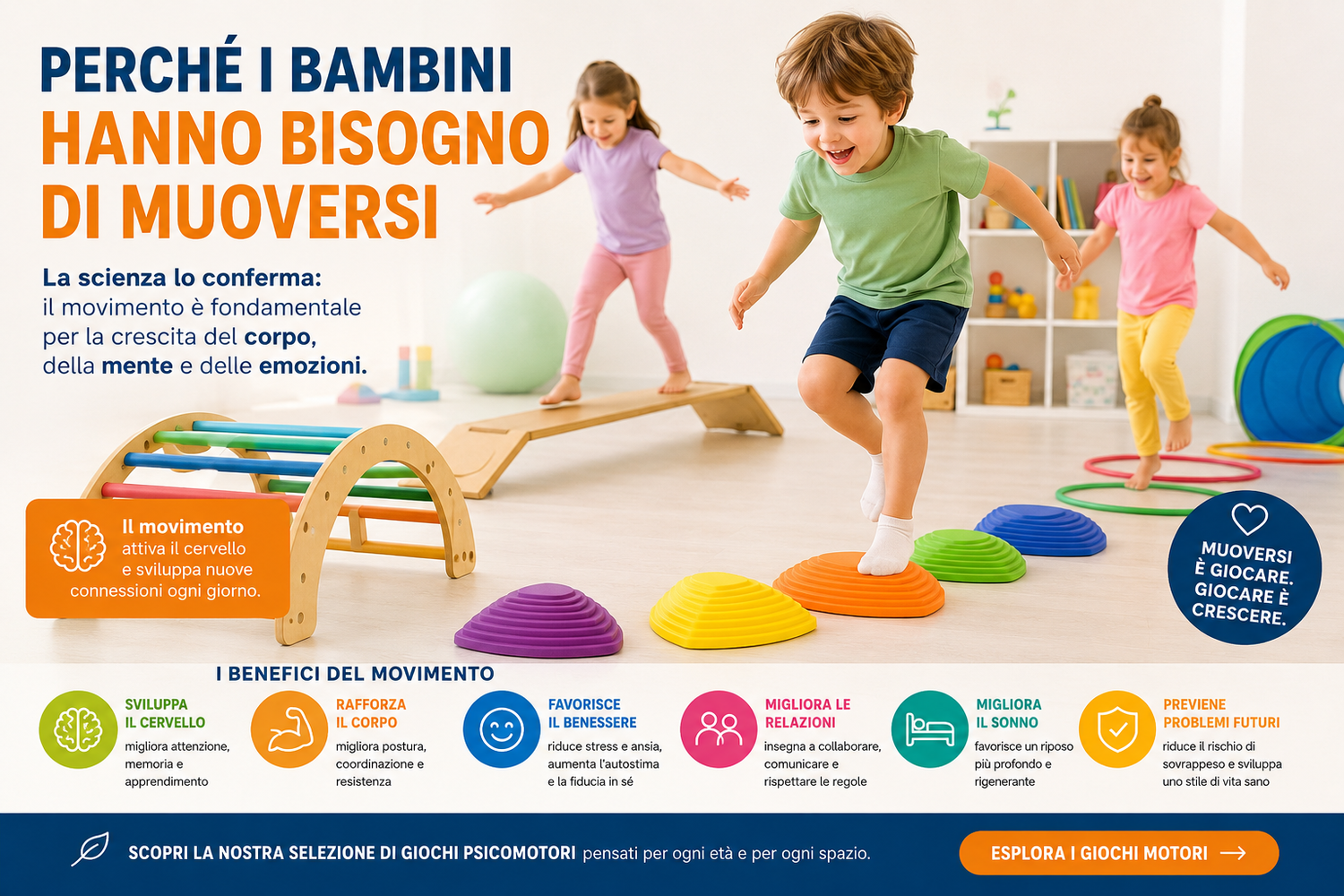
Why is movement so important for children?
If we observe a child playing, we immediately notice one thing: moving is their natural way of learning.
Running, jumping, climbing, throwing a ball, or maintaining balance are not simply fun activities. They are experiences that build the brain, strengthen the body, and support emotional development.
In recent years, numerous scientific studies have confirmed that physical activity is one of the most important elements for growth in the early years of life.
🔎Download the benefits document
The quick answer
Children need to move because movement:
-
-
- develops the brain;
- improves concentration and memory;
- strengthens muscles and bones;
- promotes balance and coordination;
- increases self-esteem;
- reduces stress and anxiety;
- improves sleep quality;
- facilitates socialization.
-
For this reason, experts recommend daily moments dedicated to active play.
What happens in the brain when a child moves?
Every movement activates millions of connections between neurons.
Jumping, walking on a line, catching a ball, or overcoming a small obstacle simultaneously stimulate:
-
-
- attention;
- memory;
- problem-solving skills;
- spatial orientation;
- eye-hand coordination.
-
In practice, the brain "learns by doing."
For this reason, many teachers use motor activities even during reading and math learning.
The physical benefits of movement
Moving every day allows children to:
-
-
- developing muscles;
- improving posture;
- increasing balance;
- strengthening the cardiovascular system;
- preventing overweight;
- improving motor coordination.
-
Even a few minutes of active play repeated daily makes a big difference.
Movement also improves emotions.
Motor play not only trains the body.
During physical activity, the brain produces substances that promote well-being, helping the child to:
-
-
- better managing frustration;
- releasing accumulated energy;
- increasing self-confidence;
- learning to collaborate with others.
-
For this reason, movement is often used in educational and psychomotor programs.
How much should children move each day?
International guidelines suggest at least 60 minutes of daily physical activity for children and teenagers.
It is not necessary to practice an organized sport.
Even simple activities like:
-
-
- run;
- jump;
- dance;
- play tag;
- build motor courses;
- use psychomotor games
-
they contribute to development.
Psychomotor games are an educational tool
Psychomotor games allow children to learn while having fun.
Through play, they develop:
-
-
- balance;
- coordination;
- laterality;
- movement precision;
- autonomy;
- safety.
-
They are activities also used by educators, kindergartens, and therapists because they promote harmonious development.

How to choose a good motor game
When buying a psychomotor game, it is useful to check that:
-
-
- is suitable for the child's age;
- stimulates natural movement;
- encourages creativity and imagination;
- is made with safe materials;
- can be used multiple times with different activities.
-
A good game grows with the child.
Frequently Asked Questions (FAQ)
Why is movement important in the early years of life?
Because it contributes to brain development, coordination, and cognitive abilities.
Can children do motor activities at home too?
Yes. There are many psychomotor games that allow balance and coordination development even in home spaces.
What are the benefits of motor play?
They improve concentration, balance, muscle development, socialization, and emotional well-being.
Are psychomotor games also useful at school?
Yes. Many schools and professionals use them to promote learning and motor development.
Help your child grow through play
Every jump, every run, and every little course represents an opportunity for growth.
For this reason, we have selected a collection of psychomotor games designed to stimulate movement, coordination, and fun in complete safety.
👉 Discover our selection of psychomotor games and choose the activity best suited to your child's age.
Play is much more than a pastime: it is one of the most effective ways to learn.


Leave a comment
All comments are moderated before being published.
This site is protected by hCaptcha and the hCaptcha Privacy Policy and Terms of Service apply.