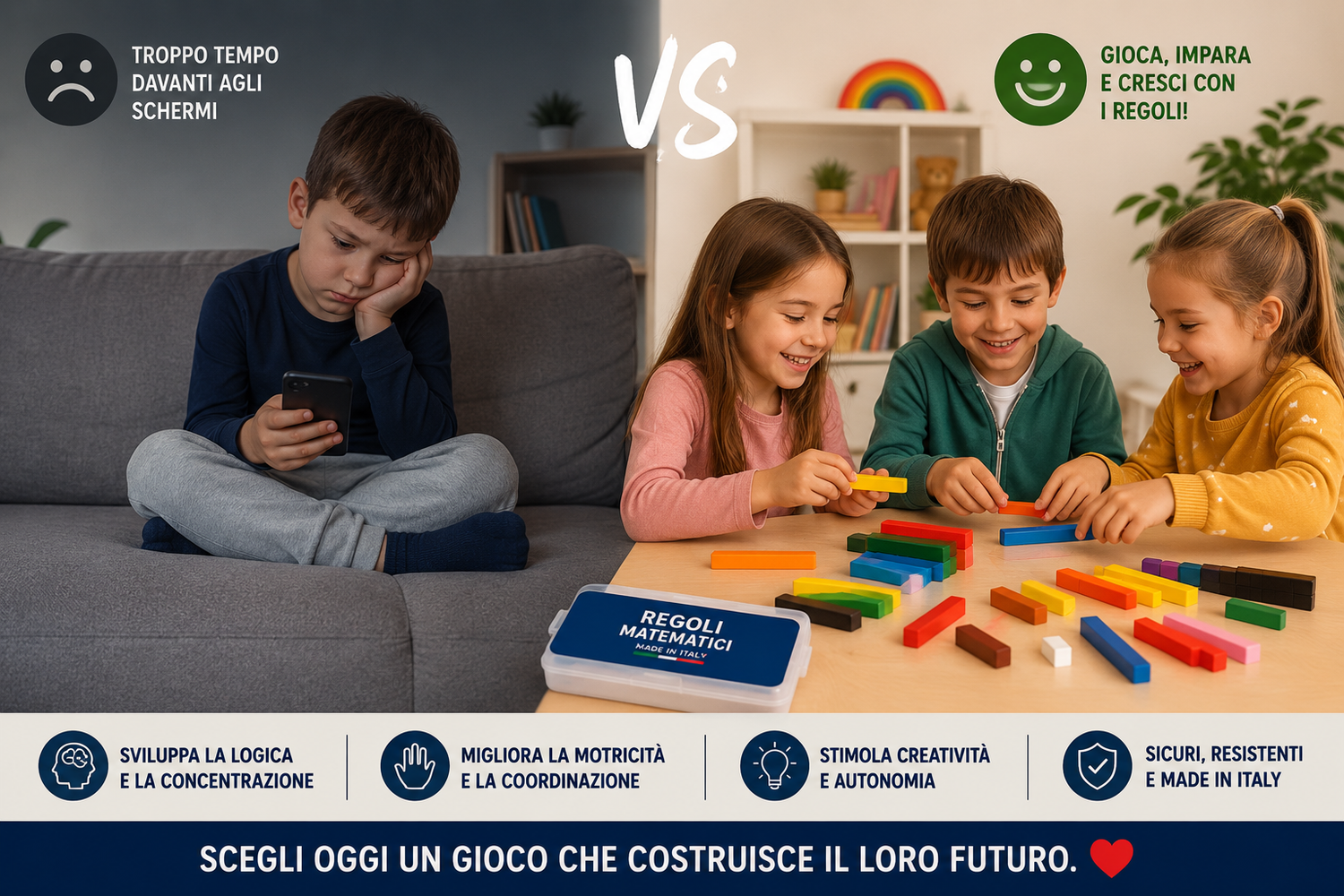
Math rods are much more than just teaching materials. Thanks to their shape, colors, and different lengths, they represent an educational tool that supports children in developing mathematical, cognitive, and emotional skills through a concrete and engaging approach.

Used for decades in preschools, primary schools, and educational enhancement programs, the rods allow children to understand complex concepts without initially resorting to abstraction. By manipulating the elements, the child naturally builds their knowledge, turning play into learning.
Why do rods facilitate learning mathematics?
During the early years of life, the brain learns primarily through direct experience. Touching, comparing, ordering, and building allow children to understand mathematical relationships that might be harder to grasp if presented only symbolically.
Rods make concepts like quantity, measurement, equivalence, addition, subtraction, multiplication, and division immediately visible. Each operation can be observed and verified with the eyes and hands, promoting a deeper understanding beyond simple memorization.
This approach reduces fear of mathematics and makes learning more spontaneous and motivating.
An important support for cognitive development
Using rods stimulates numerous fundamental cognitive functions essential for a child's growth.
Through manipulative activities, observation skills, logical reasoning, working memory, sustained attention, and problem-solving abilities are trained. Every construction, comparison, or combination requires the child to formulate hypotheses, verify them, and correct them independently.
These skills form the foundation not only for mathematical learning but also for scientific thinking and problem solving that will accompany the child throughout their schooling.


Psychological benefits: learning without fear of making mistakes
One of the most interesting aspects of rods is their impact on the child's psychological well-being.
Mistakes are not seen as failures but as a natural part of the experience. If a construction doesn’t work or an operation is incorrect, the child can immediately rearrange the rods until finding the solution.
This process encourages:
-
greater confidence in their abilities;
-
development of self-esteem;
-
reduction of performance anxiety;
-
perseverance in achieving goals;
-
autonomy in decision-making.
Learning through experimentation makes the child more self-assured and more willing to face new challenges.
Development of concentration and attention
Activities with rods require precision, observation, and the ability to maintain attention for progressively longer periods.
Building a sequence, comparing lengths, or reproducing a model helps the child naturally train concentration without feeling like they are doing traditional school exercises.
For this reason, rods are often used in workshops dedicated to enhancing executive functions.
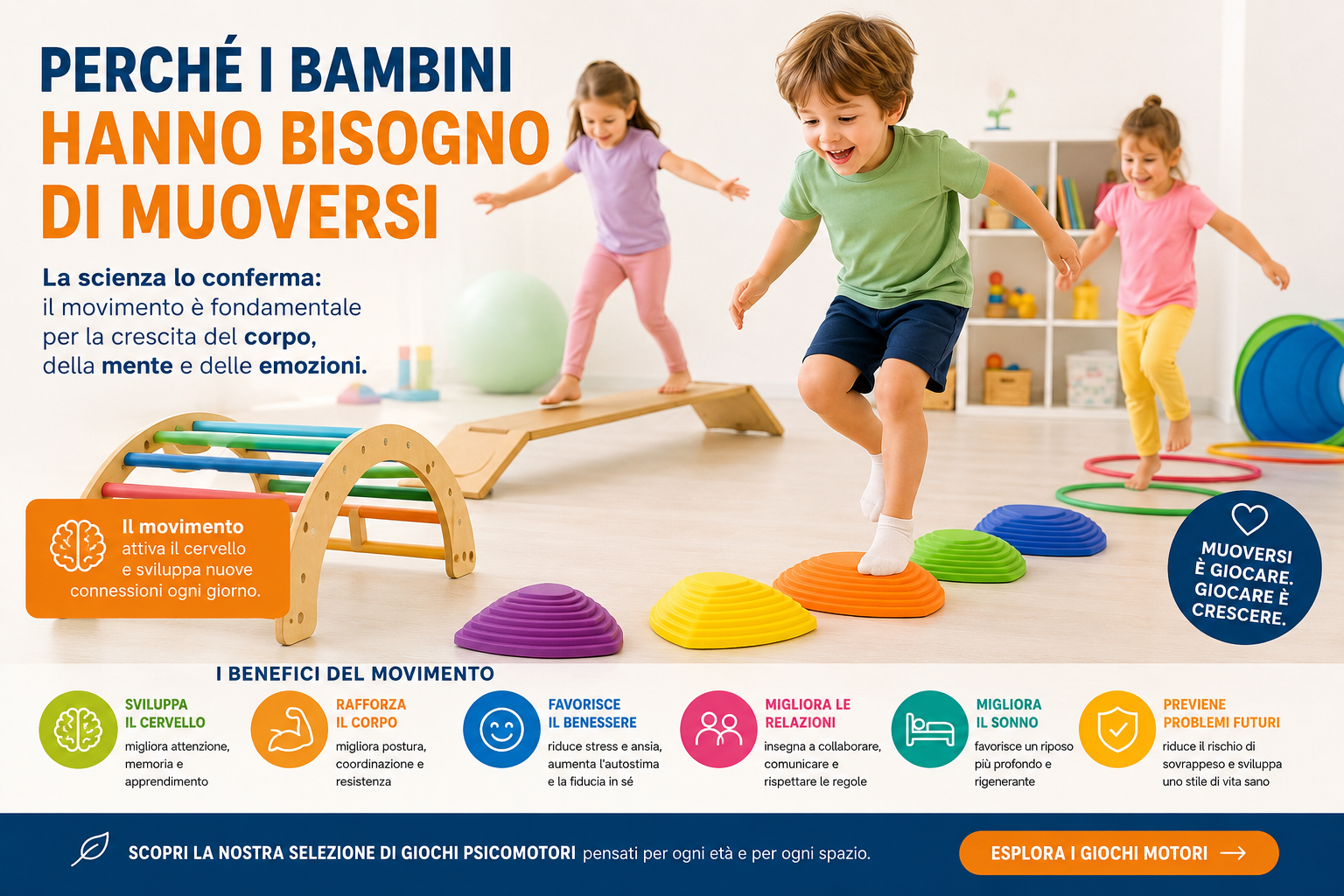
Coordination and fine motor skills
Each rod must be grasped, moved, and placed precisely.
These simple movements contribute to the development of fine motor skills, hand-eye coordination, and movement control—abilities essential for writing, drawing, and many daily activities.
Creativity and imagination
Although a mathematical tool, rods strongly stimulate creativity.
The different shapes and colors allow children to build objects, figures, letters, animals, buildings, and original compositions. This expressive freedom fosters divergent thinking, the ability to find alternative solutions, and imagination.
The child does not just learn mathematics but simultaneously develops artistic, spatial, and design skills.
An inclusive tool
Thanks to their concrete and visual approach, rods are especially appreciated in inclusive educational paths.
They can facilitate learning for children with different cognitive styles and are useful when it is necessary to make abstract concepts more understandable through practical and manipulative experiences.
Learning thus becomes more accessible, engaging, and customizable according to each child's needs.
Made in Italy rods: quality and safety
When choosing rods for children, it is important to also pay attention to the quality of the materials.
Rods made in Italy with plastics certified for use by children guarantee high standards of safety, durability, and longevity. Bright colors, precise dimensions, and non-toxic materials ensure daily use both at school and at home, offering the peace of mind of a product designed to accompany the child in their growth journey.
Frequently asked questions
At what age are rods recommended?
Rods can be introduced as early as 3 years old with simple activities and accompany the child through primary school, progressively adapting to their developmental level.
Why are rods considered an effective tool?
Because they transform abstract concepts into concrete experiences. The child sees, touches, and directly experiments with what they are learning, facilitating understanding and memorization.
Do rods only help with mathematics?
No. They also promote the development of logic, concentration, fine motor skills, creativity, autonomy, and problem-solving abilities.
Are they suitable for use at home as well?
Yes. Rods are an ideal educational tool both for school activities and shared family play, turning every moment into a learning opportunity.
Conclusion
Math rods represent an educational investment that goes far beyond teaching numbers. They promote harmonious development of the child, stimulating reasoning, creativity, self-confidence, and the joy of learning.
Thanks to their practical, intuitive, and engaging approach, they continue to be one of the most appreciated teaching tools by teachers, educators, and families. Choosing quality rods means offering children a concrete, safe learning experience that supports them in their academic and personal growth.

Leave a comment
All comments are moderated before being published.
This site is protected by hCaptcha and the hCaptcha Privacy Policy and Terms of Service apply.