Montessori Method and psychomotricity: how to choose the right games
Games are not just entertainment tools: they represent one of the most effective means to support the child's motor, cognitive, and emotional development. Among the educational approaches most appreciated by parents are the Montessori Method, which promotes autonomy and learning through direct experience, and psychomotricity, a discipline that values movement as a fundamental element of growth.
But how to really choose the most suitable game?
In this guide, you will discover the characteristics a good educational game should have and how to identify the right one based on the child's age.
What is the Montessori Method?
The Montessori Method was born from the experience of the Italian educator Maria Montessori and is based on some fundamental principles:
- to promote autonomy;
- to learn by doing;
- to respect the child's natural timing;
- to use simple and sensory materials;
- to stimulate concentration.
According to this philosophy, play should not entertain passively but allow the child to experiment, observe, self-correct, and improve independently.
What is psychomotricity?
Psychomotricity considers movement as an integral part of a person's development.
Every gesture helps develop:
- balance;
- coordination;
- spatial orientation;
- body perception;
- self-confidence.
For this reason, psychomotor games are widely used both in preschools and in home educational paths.
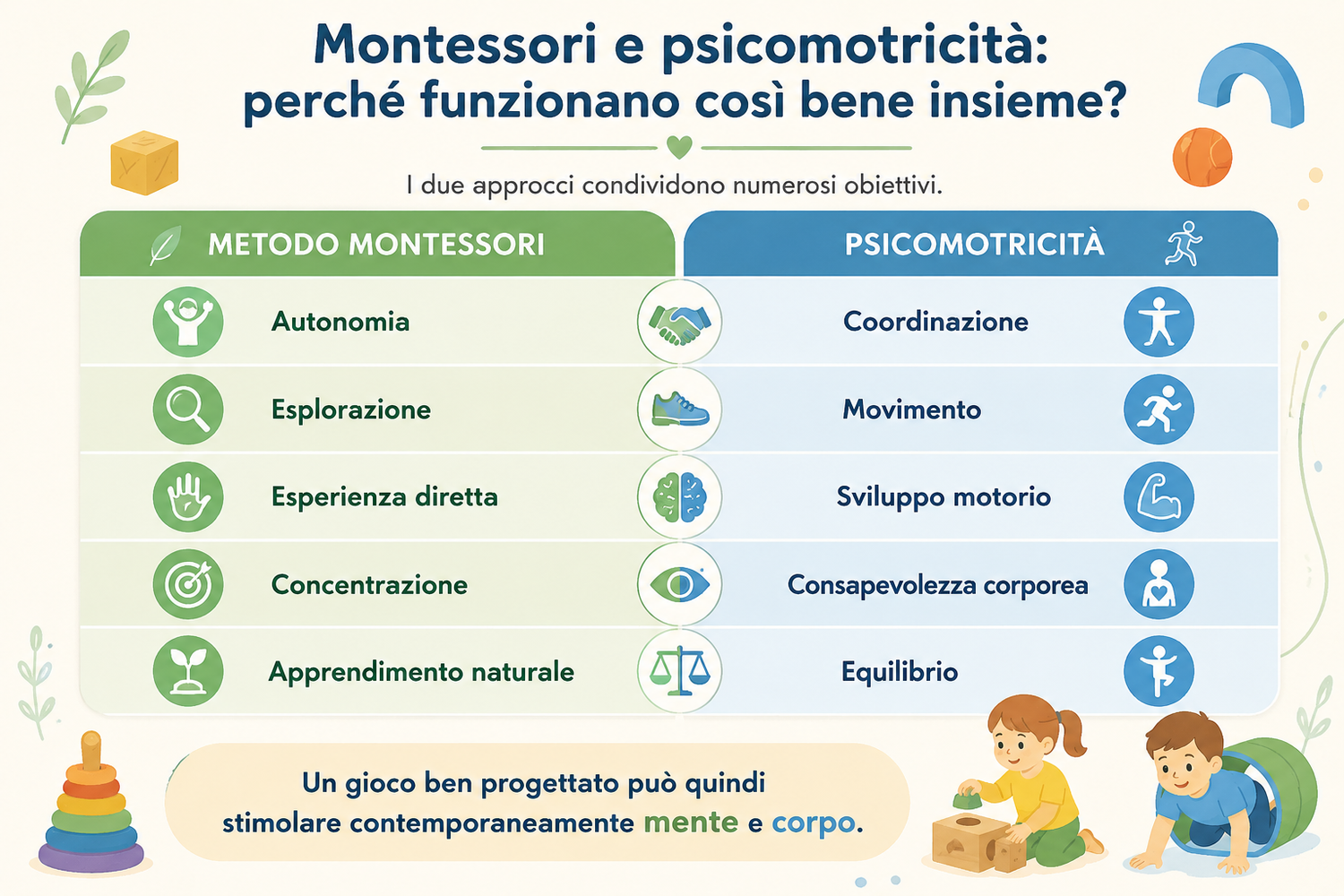
Montessori and psychomotricity: why do they work so well together?

How to choose a Montessori game
A good Montessori game should have some specific characteristics.
1. Natural materials
Wood, fabrics, and durable materials enhance the sensory experience.
2. Only one educational goal
Each activity should focus on a specific skill:
- to thread;
- to stack;
- to classify;
- to count;
- to fit together.
3. No electronic effects
Learning comes from the child's action, not from automatic lights or sounds.
4. Possibility of self-correction
The child should be able to understand on their own when an activity has been completed correctly.
How to choose a psychomotor game
The best psychomotor games help develop:
Coordination
- motor paths;
- hoops;
- soft obstacles.
Balance
- low beams;
- platforms;
- proprioceptive boards.
Fine motor skills
- constructions;
- beads;
- puzzles;
- manual activities.
Gross motor skills
- climbing;
- tunnel;
- jumps;
- soft modules.


Recommended games by age group
0-12 months
Goals:
- sensory stimulation;
- grasp;
- observation.
Ideal:
- wooden gyms;
- natural rattles;
- Montessori spheres.
1-2 years
The child begins to walk and wants to experiment.
Perfect:
- stackable cubes;
- pink tower;
- simple puzzles;
- first motor paths.
2-3 years
They develop:
- coordination;
- language;
- imitation.
Excellent:
- Montessori kitchens;
- balance games;
- sensory boards;
- large constructions.
3-6 years
It is the ideal time to develop:
- logic;
- precision;
- autonomy.
Recommended:
- sandpaper letters;
- math games;
- psychomotor paths;
- balance modules.
Mistakes to avoid
Many parents choose games based solely on aesthetic appearance.
The most common mistakes are:
- buying games that are too complex;
- choosing products with too many functions at once;
- constantly replacing the game without allowing time for exploration;
- offering activities not suitable for the age.
The quality of the experience is much more important than the quantity of games available.
🔎Discover the rules for choosing psychomotor games
Why wood is often the best choice
Montessori games frequently use wood because:
- is durable;
- offers an authentic tactile experience;
- stimulates sensory perception;
- it is generally more sustainable than plastic;
- accompanies the child for many years.
A good wooden game can also be used by younger siblings, maintaining its educational value intact.
How to create a Montessori space at home
There is no need to completely transform a room.
Just a few adjustments are enough:
- low shelves;
- few well-organized games;
- easily accessible materials;
- periodic rotation of activities;
- organized environment.
This way, the child will naturally be led to choose and use the game independently.
Documented benefits of psychomotor games
Regular use of motor games promotes:
- development of balance;
- hand-eye coordination;
- concentration;
- problem-solving skills;
- confidence in one's abilities;
- development of autonomy;
- socialization during shared play.
These skills also prove valuable in later school learning.
Frequently Asked Questions (FAQ)
Are Montessori games suitable for all children?
Yes. The Montessori approach can be adapted to different ages and developmental paces by choosing activities proportional to the child's abilities.
What is the difference between a Montessori game and a regular educational game?
A Montessori game focuses mainly on autonomy, self-correction, and learning through direct experience, avoiding unnecessary electronic stimuli.
From what age can psychomotor games be used?
There are options suitable from the first months of life. It is important to select products designed for the specific age group and always follow the manufacturer's instructions.
How many Montessori games are needed?
Few but well-chosen. A limited number of quality games, rotated over time, promotes concentration and engagement.
Wood or plastic?
For many educational games, wood offers durability, a better sensory experience, and longer-lasting use, although the most important aspect remains the quality of the educational design.

Leave a comment
All comments are moderated before being published.
This site is protected by hCaptcha and the hCaptcha Privacy Policy and Terms of Service apply.