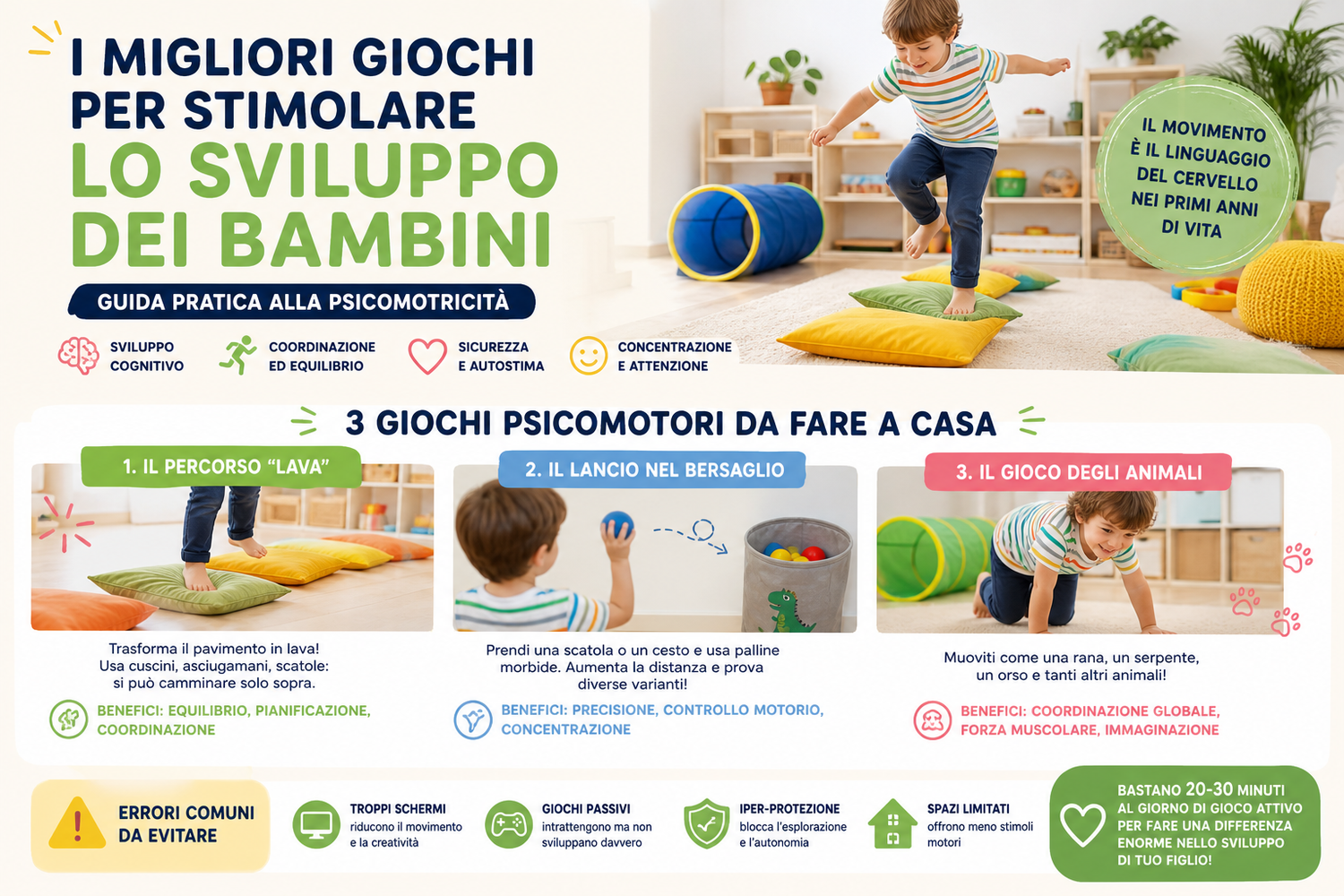
What psychomotricity is and why it is fundamental in the early years
Psychomotricity is the link between movement, mind, and emotions. In children, it is not just "playing": it is the main way they develop:
-
- coordination
- balance
- space perception
- self-confidence
- basic cognitive abilities
In the first 6 years of life, movement is the brain's main language. Without psychomotor stimulation, development can be slower or less harmonious.
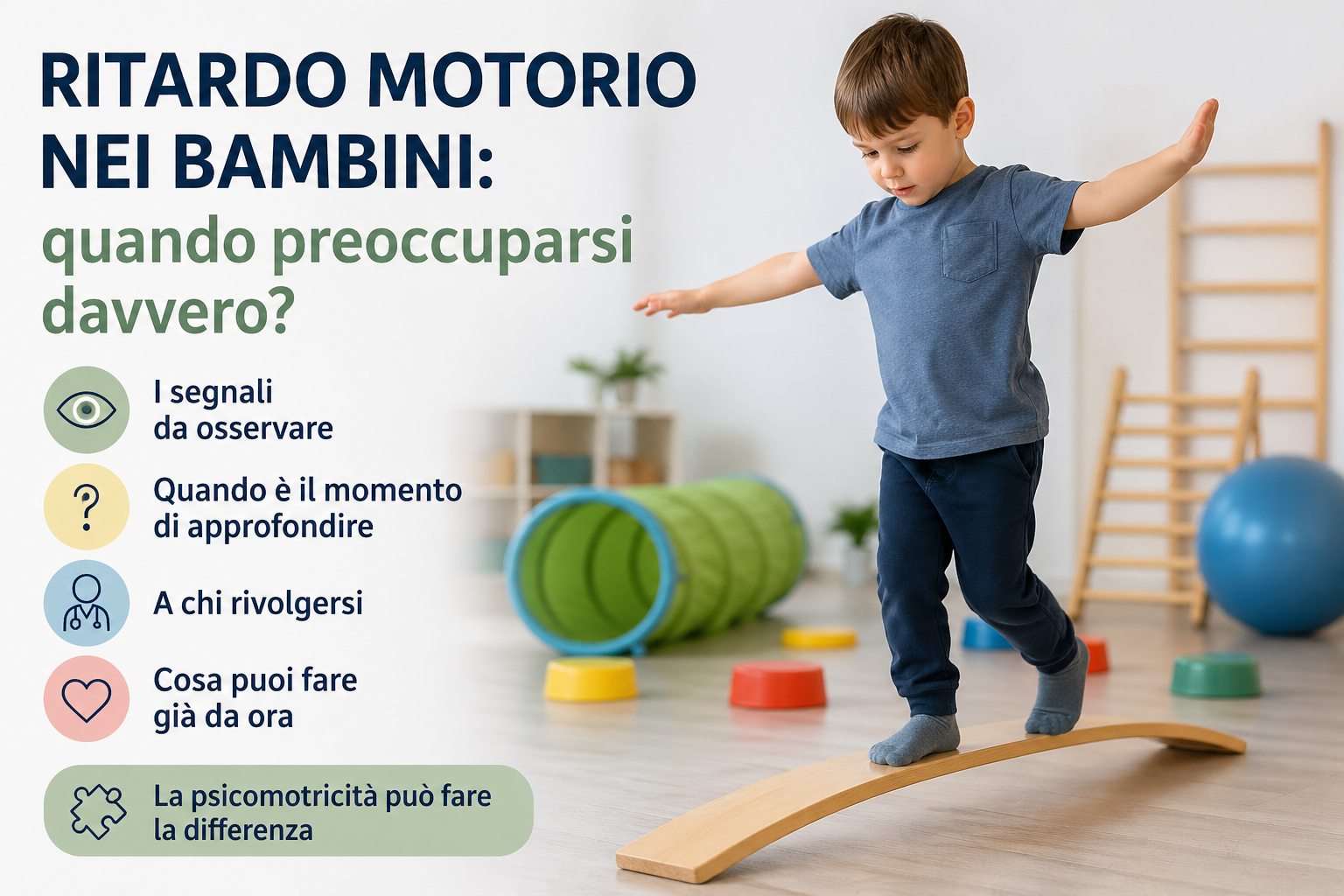
🔎Discover how to recognize a motor deficit
What are the best games to stimulate children's development?
Not all games are really useful. Many entertain, few develop.
The best psychomotor games have 3 characteristics:
-
- They involve the body (not just the hands)
- They require coordination or balance
- They stimulate decision and autonomy
1. Motor paths (indoor)
Cushions, chairs, rugs: everything can become a path.
What it develops:
-
- balance
- movement planning
🔎Discover which games can be used
2. Throwing and aiming games
Soft balls, hoops, containers.
What it develops:
- eye-hand coordination
- force control
- concentration
3. Body imitation games
"Do as I do": jump, crawl, walk like animals.
What it develops:
-
- body awareness
- motor memory
- attention
4. Large constructions (not just Lego)
Large, modular blocks to stack or cross.
What it develops:
-
- fine and gross motor skills
- spatial logic
- creativity
5. Balance games
Low beams, lines on the floor, unstable surfaces.
What it develops:
-
- posture
- stability
- movement confidence
3 psychomotor games to play at home (right away, without buying anything)
Here we enter the part that really converts: immediate action.
1. The "lava" path
Turn the floor into lava.
How to do it:
-
- Use cushions, towels, boxes
- The child can only move on these elements
Goal:
do not touch the floor
Benefits:
-
- balance
- planning
- coordination
2. Target throwing game
Simple but very powerful.
How to do it:
-
- Take a box or a basket
- Use balls or soft objects
- Increase the distance gradually
Variants:
-
- with one hand
- while sitting
- after a jump
Benefits:
-
- precision
- motor control
- concentration
3. The animal game
Fun and very complete.
How to do it:
Ask the child to move like:
-
- frog (jumps)
- snake (crawling)
- bear (walking on all fours)
Benefits:
-
- overall coordination
- muscle strength
- imagination
Common mistakes to avoid (that limit development)
Here I push you a little, because it is important:
-
- Too many screens → reduce real movement
- Passive games → entertain but do not develop
- Overprotection → blocks exploration
- Too limited spaces → fewer motor stimuli
If your child "plays quietly" for hours without moving, it is not an advantage.
How to choose the right game for your child
Ask yourself these 3 questions:
-
- Is the child really moving or staying still?
- Does the child need to coordinate or is it automatic?
- Can the child experiment or is it guided?
If the answer to these is "no," the game is not psychomotor.
FAQ
What is the best game to develop coordination in children?
Throwing and aiming games are among the most effective for developing hand-eye coordination and motor control.
At what age should psychomotor games start?
From the first months of life, adapting activities to the child's age.
Are specific games needed or are household objects enough?
Common objects are enough: pillows, boxes, balls. The important thing is the type of activity, not the product.
How much time should be dedicated to psychomotor activities?
Even 20 minutes a day is enough if the game is active and engaging.

Leave a comment
All comments are moderated before being published.
This site is protected by hCaptcha and the hCaptcha Privacy Policy and Terms of Service apply.