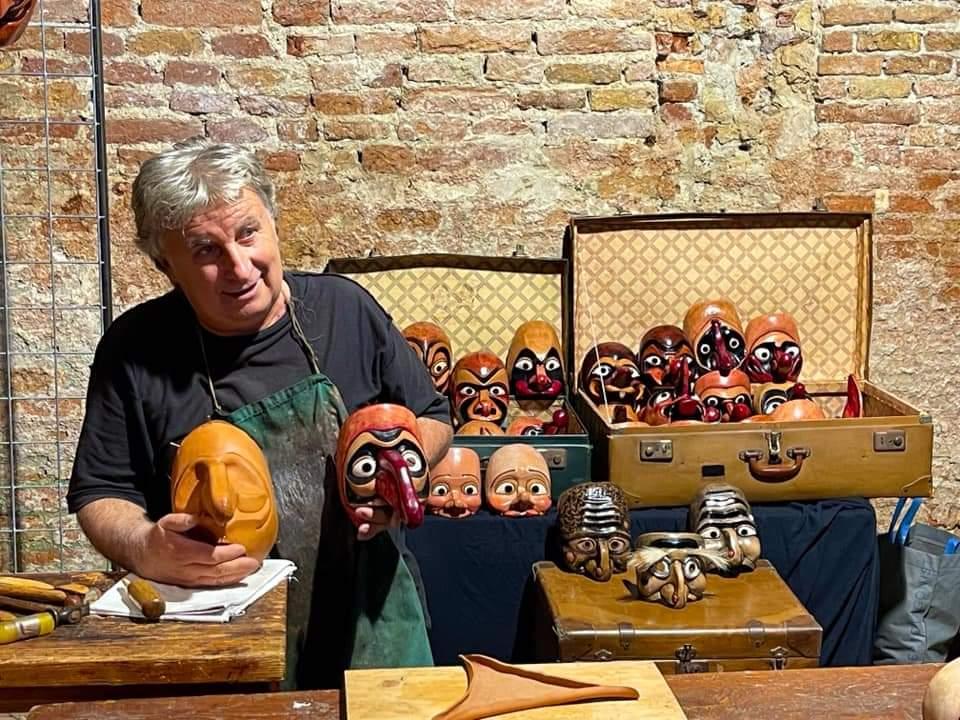
Giorgio De Marchi, artist and sculptor of theatrical masks, lives in Montegalda, in the heart of the Vicenza province, and works in his workshop called Fucinafole in Toara di Villaga. Known as a "mascarer," De Marchi has transformed the ancient art of mask-making into a unique artistic language, blending tradition and innovation.
The meeting with Dino Formaggio: The turning point
In 1986, De Marchi met Professor Dino Formaggio , one of the most important scholars of aesthetics. This meeting marked a fundamental stage in the sculptor's career. Formaggio, in his essay "The Masks of Man ," defines De Marchi's work as "the transition from a precious craftsmanship to a true art," acknowledging its artistic value and profound expressive sensitivity.
Excellent collaborations: Sarzi, Scaparro and Le Bon
De Marchi's career is studded with prestigious collaborations that have enriched his artistic vision. Among the most well-known is Otello Sarzi , master puppeteer, with whom he has collaborated on numerous projects. Another significant encounter was with Maurizio Scaparro , renowned theater director, and Alain Le Bon , actor and director, as well as director of the Maison de Polichinelle in Saintes. These collaborations have broadened the horizons of his creations, allowing his masks to cross the borders of Italy and reach international theaters.
The evolution of the theatrical mask
One of the distinctive features of Giorgio De Marchi's work is his innovative approach to theatrical masks . De Marchi doesn't simply create conventional masks, but breaks them down into essential parts—such as the eyes, nose, mouth, or chin—to emphasize specific expressive features. This approach allows the mask to interact directly with the acting, making speech and facial movement more effective.
De Marchi's masks are not just stage props, but become true vehicles of emotion . Through the reduction and superimposition of facial features, the artist manages to create a dramatic tension that perfectly suits the characters who wear them, giving them an aura of mystery and unease. Venetian masks have a new composer.
Psychology and Mask: A Modern Approach
De Marchi's art is also distinguished by the introduction of modern psychological concepts into the creation of his masks. His works reflect an in-depth study of the character and expressiveness of the individual. This study allows him to breathe new life into the traditional concept of the mask and the Venetian mask, restoring it to its original meaning, but with a contemporary freshness that enriches the theater with unexpected and original results.
Exhibitions and workshops: An art without borders
Giorgio De Marchi's creations have crossed Italian borders to be appreciated abroad. In particular, his exhibitions and workshops have found fertile ground in France and Brazil, where the artist has held workshops for theater enthusiasts and professionals. Since 2016, De Marchi has collaborated with actress Nora Fuser , with whom he has developed new artistic projects, further strengthening his influence in the world of contemporary theater.
Conclusion
Giorgio De Marchi is an artist who has reinvented the ancient tradition of theatrical masks and Venetian masks, taking them to new levels of expression. His work, which blends craftsmanship with true art, exemplifies how masks can be powerful tools for expressing profound emotions and conveying complex meanings. Thanks to his international collaborations and his ongoing study of the human character, De Marchi continues to leave an indelible mark on the world of theater.



Leave a comment
All comments are moderated before being published.
This site is protected by hCaptcha and the hCaptcha Privacy Policy and Terms of Service apply.