If you're thinking of installing an induction hob or other powerful appliances, choosing the right electricity meter is crucial.
In Italy, the two main types are domestic and industrial . The differences are not only technical, but also economic and practical.
1. Available power: the first big gap
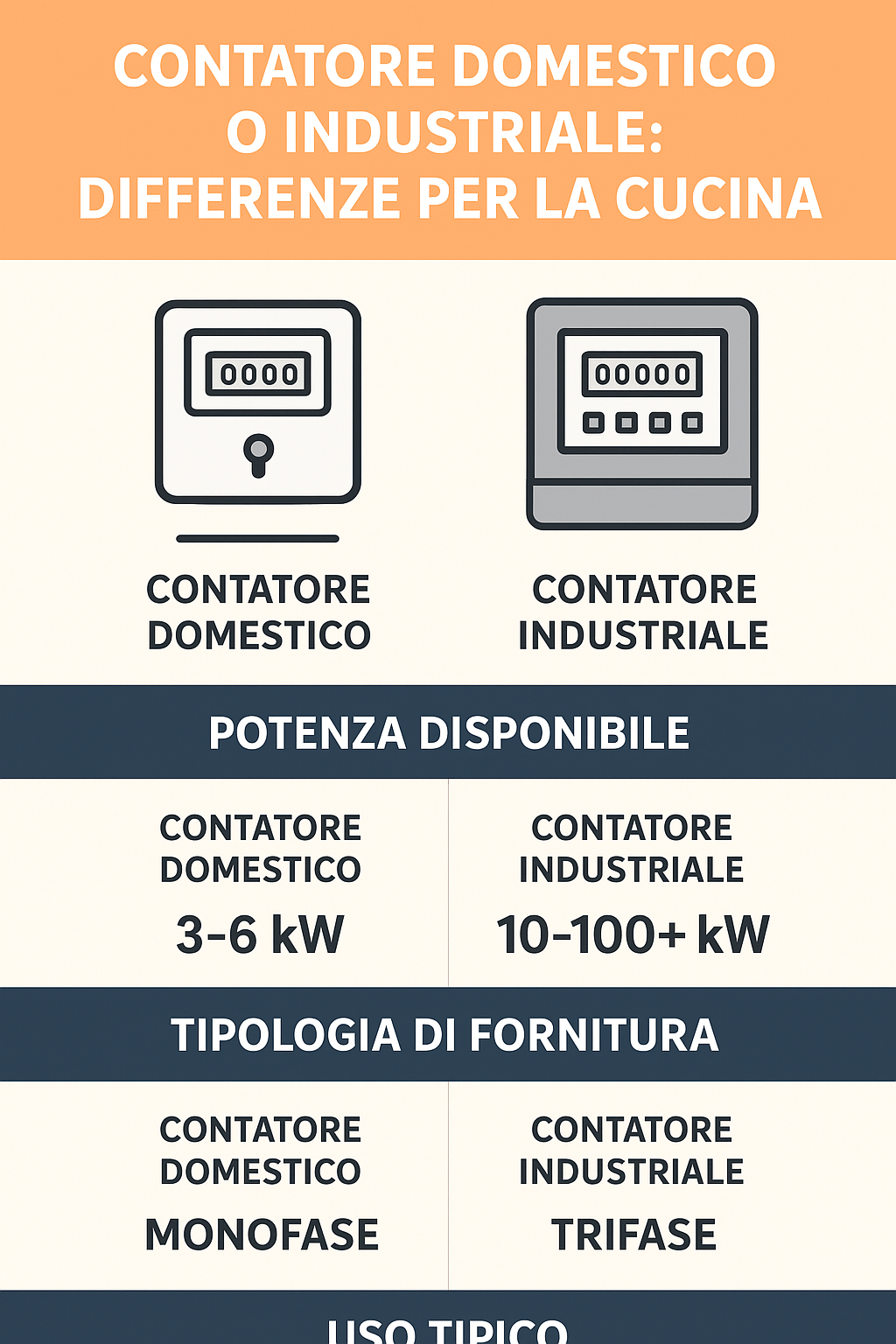
Home meter
-
Standard power: 3 kW (extendable to 4.5 or 6 kW).
-
Perfect for an average apartment.
-
With an induction hob at full power (2.8–7.5 kW) a power increase may be necessary.
Industrial meter
-
Power from 10 kW up to over 100 kW.
-
Designed for restaurants, laboratories and professional kitchens with multiple appliances in use simultaneously.
💡 Helpful tip : if you cook a lot and have several high-drain appliances, consider a more powerful domestic one before switching to an industrial one.
2. Single-phase vs. three-phase: power management changes
-
Domestic → almost always single-phase (230V), sufficient for family use.
-
Industrial → almost always three-phase (400V), distributes loads better and allows the simultaneous use of more powerful appliances.
3. Fixed costs and rates
-
Domestic : low fixed costs, but higher per kWh rate for large consumption.
-
Industrial : higher fixed costs, but cheaper price per kWh if you consume a lot.
📌 Note : an industrial meter with no real power requirement leads to unnecessary expenses.
4. Context of use
-
Domestic → houses, apartments, small accommodation facilities.
-
Industrial → professional kitchens, hotels, canteens, pastry shops.
5. Induction cooktop: which counter to choose?
-
At home → for a 4-zone hob (max 7.2 kW) a 4.5 or 6 kW domestic hob is sufficient, preferably with automatic power limitation .
-
In professional activities → an industrial three-phase of 10 kW or more ensures stability and continuity.
👉 Regulations on electrical systems for induction
Summary table
| Characteristic | Domestic | Industrial |
|---|---|---|
| Typical power | 3-6 kW | 10-100+ kW |
| Current type | Single-phase | Three-phase |
| Fixed annual cost | Bass | High |
| Energy rates | Higher on large consumptions | Lower on large consumptions |
| Typical use | Houses, B&Bs | Restaurants, hotels |
FAQ – Frequently Asked Questions (SGE optimized)
How much power do you need for a home induction cooktop?
For family use with a 4-zone hob, 4.5 or 6 kW are often sufficient, especially with a power limiting function.
Can I install an industrial meter at home?
Technically yes, but economically it's not worth it: the annual fixed costs are higher and there are no advantages if you don't take advantage of the extra power.
Is single-phase or three-phase better for a professional kitchen?
Always three-phase: distributes loads better and prevents voltage drops.
If I increase the power of my home meter, will the tariff change?
Yes, the annual fixed cost increases slightly, but remains much lower than an industrial contract.
Conclusion
The choice between a domestic and industrial meter depends on how much and how you use your appliances.
For most home induction cookers, a boosted home meter is sufficient.
In a professional context, however, the power and stability of the industrial meter are essential.

Leave a comment
All comments are moderated before being published.
This site is protected by hCaptcha and the hCaptcha Privacy Policy and Terms of Service apply.