Induction cooking is becoming increasingly popular in the kitchen thanks to its precision, safety, and energy efficiency. But how does it perform when we need to cook vegetables ? And what are the ideal cooking times and heat levels for healthy, tasty dishes?
Pros of induction cooking for vegetables
-
Temperature control : allows you to precisely adjust the heat level, avoiding overcooking.
-
Speed : Water reaches a boil much faster than gas.
-
Energy efficiency : up to 90% of the energy is transferred to the pan.
-
Better nutrient retention : short cooking times and gentle cooking preserve vitamins and minerals.
-
Safety : the surface remains cool and the risk of burns is reduced.
👉 Discover the solutions available today
Cons of induction cooking for vegetables
-
Dedicated pans : not all pans are compatible, ferrous material is required.
-
Learning curve : Those used to gas must adapt to the numerical power levels.
-
Initial cost : Induction hobs are more expensive than traditional cooktops.
-
Absence of “open flame” : Some cooks feel that the sensation of direct cooking is missing.
Power levels and cooking times for the main vegetables
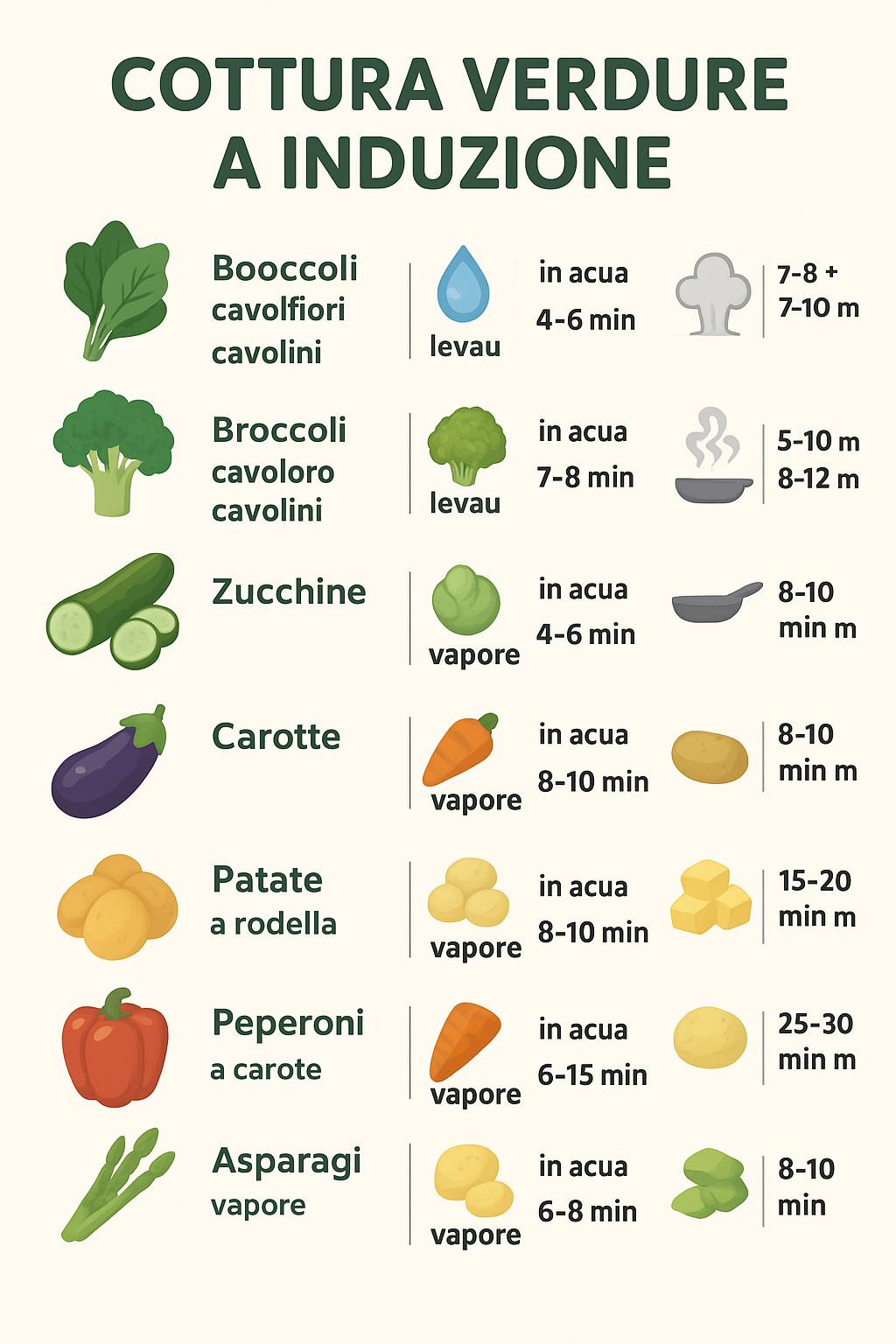
Here's a practical guide to cooking vegetables optimally on an induction hob. The levels indicated refer to a scale from 1 to 9 (typical of induction hobs).
Leafy greens (spinach, chard, kale)
-
Cooking in water : level 7 until boiling, then level 4-5 for 4-6 minutes.
-
Steam cooking : level 6, 5-7 minutes.
Cruciferous vegetables (broccoli, cauliflower, Brussels sprouts)
-
In water : boil at level 7-8, then 5 for 7-10 minutes.
-
Steam : level 6, 8-12 minutes.
Zuchinis
-
In water : level 6, 4-6 minutes.
-
In a pan with oil : level 5-6 for 6-8 minutes, stirring often.
Eggplant
-
In a pan in cubes : level 6-7, 8-10 minutes.
-
Steamed : level 6, 10-12 minutes.
Carrots (tuber)
-
Sliced in water : boil at level 8, then 5 for 8-10 minutes.
-
Steam whole : level 6, 15-20 minutes.
Potatoes (tuber)
-
Diced in water : boil at level 8, then 5 for 10-12 minutes.
-
Whole in water : level 8 until boiling, then 5 for 25-30 minutes.
-
Steamed : level 6, 20-25 minutes.
Peppers
-
In a pan : level 6-7, 8-10 minutes.
-
Steamed : level 6, 10 minutes.
Asparagus
-
In water : boil at level 7, then 5 for 6-8 minutes.
-
Steam : level 6, 8 minutes.
Final advice
With induction cooking the secret is to always start with a high level (7-9) to bring to the boil , then lower to a medium level (4-6) to maintain uniform cooking without losing nutrients.
The speed of induction allows you to save time and preserve the flavor and properties of vegetables, making it an ideal choice for those who love healthy and balanced cooking.
FAQ – Induction cooking and vegetables
1. Does induction cooking ruin vegetables?
No, on the contrary: the speed of cooking preserves vitamins and minerals better than gas.
2. Is it better to cook vegetables on an induction hob in water or steam?
Steaming is the best choice: it retains color, flavor, and nutrients.
3. At what level should you cook vegetables on an induction hob?
Start on high (7-9) to bring to a boil, then reduce to medium (4-6) to finish cooking.
4. How long do potatoes last on induction?
-
Cubes: 10-12 min
-
Whole: 25-30 min
-
Steam: 20-25 min
5. Can you sauté vegetables in a pan on an induction hob?
Yes: just set level 6-7 for quick and even cooking.
6. What is the main advantage of induction over gas for vegetables?
Time saving (water boiling in minutes) and greater heat control.

Leave a comment
All comments are moderated before being published.
This site is protected by hCaptcha and the hCaptcha Privacy Policy and Terms of Service apply.