Induction cooktops are now the heart of the modern kitchen: efficient, elegant, and sustainable.
But when it comes to choosing, many wonder:
👉 Is an induction cooktop with a built-in oven or an induction hob without an oven better?
The answer depends on space, style, and cooking habits —but also on understanding how induction works technically and the possible effects between the hob and the oven.
In this article by Rostilia.com , we analyze in detail the pros and cons , thermal interference and how Italian kitchens have solved compatibility problems between appliances.
How an induction cooker works
The basic principle is simple but revolutionary:
a magnetic coil located under the glass ceramic generates an electromagnetic field that heats the pan directly , and not the hob.
In practice:
-
The heat originates at the bottom of the pan , it is not transmitted by the glass.
-
Heat loss is minimal (over 90% efficiency).
-
The temperature is controlled with millimetric precision , even for long cooking times.
-
After a few seconds of switching off, the hob becomes cool to the touch again.
This technology reduces consumption, improves safety and keeps the kitchen environment cooler.
🔎Find out the difference between free-standing and built-in installation
Interference between ovens and induction hobs: what you need to know
When combining an induction hob with an electric oven in the same unit, thermal or magnetic interference may occur if the design is not well thought out.
Possible critical issues:
-
Excessive heating of the lower compartment of the hob if the oven is not adequately insulated.
-
Heat dissipation which can reduce the efficiency of the magnetic field.
-
Hob temperature sensors that automatically switch off during oven use.
How Italian kitchens solve the problem
Italian manufacturers have long since resolved these critical issues by adopting:
-
Heat-reflecting insulation panels between the oven and the hob.
-
Forced ventilation ducts , which prevent heat from accumulating under the glass ceramic.
-
Magnetic shielding systems that prevent interference between the hob and oven electronics.
Thanks to these solutions, made in Italy kitchens guarantee maximum efficiency , durability and total safety , even in compact configurations.
🔎Discover the range of Italian kitchens chosen for you by Rustilia
Induction cooktops with built-in ovens: advantages and disadvantages
Advantages
-
All in one
A practical and complete solution for those who want a single kitchen unit, ideal for small spaces. -
Coordinated design
Uniform aesthetics, typical of Rostilia kitchens: elegant, linear, functional. -
Simplified installation
A single electrical connection, quick to set up. -
Space optimization
Perfect for small apartments, lofts or holiday homes.
Disadvantages
-
High simultaneous consumption
An oven and induction hob together may require power of 6 kW or more. -
Slower cooling of the lower compartment
In less insulated (non-Italian) models, the heat from the oven can interfere with the hob sensors. -
Less flexibility
If one of the two elements fails, it may be necessary to intervene on the entire unit.
Induction hobs without ovens: advantages and disadvantages
Advantages
-
Freedom of composition
The hob can be combined with any electric or steam oven, even a separate built-in one. -
Independent consumption management
You only use what you need, reducing energy waste. -
Easier maintenance
You can replace the hob or oven individually without touching the other. -
Customizable aesthetics
Available in many finishes and colors, from glossy black glass to satin gray.
Disadvantages
-
More complex installation
Requires separate arrangements for hob and oven. -
Higher initial cost
Two separate devices require a higher investment, even if it is longer-lasting.
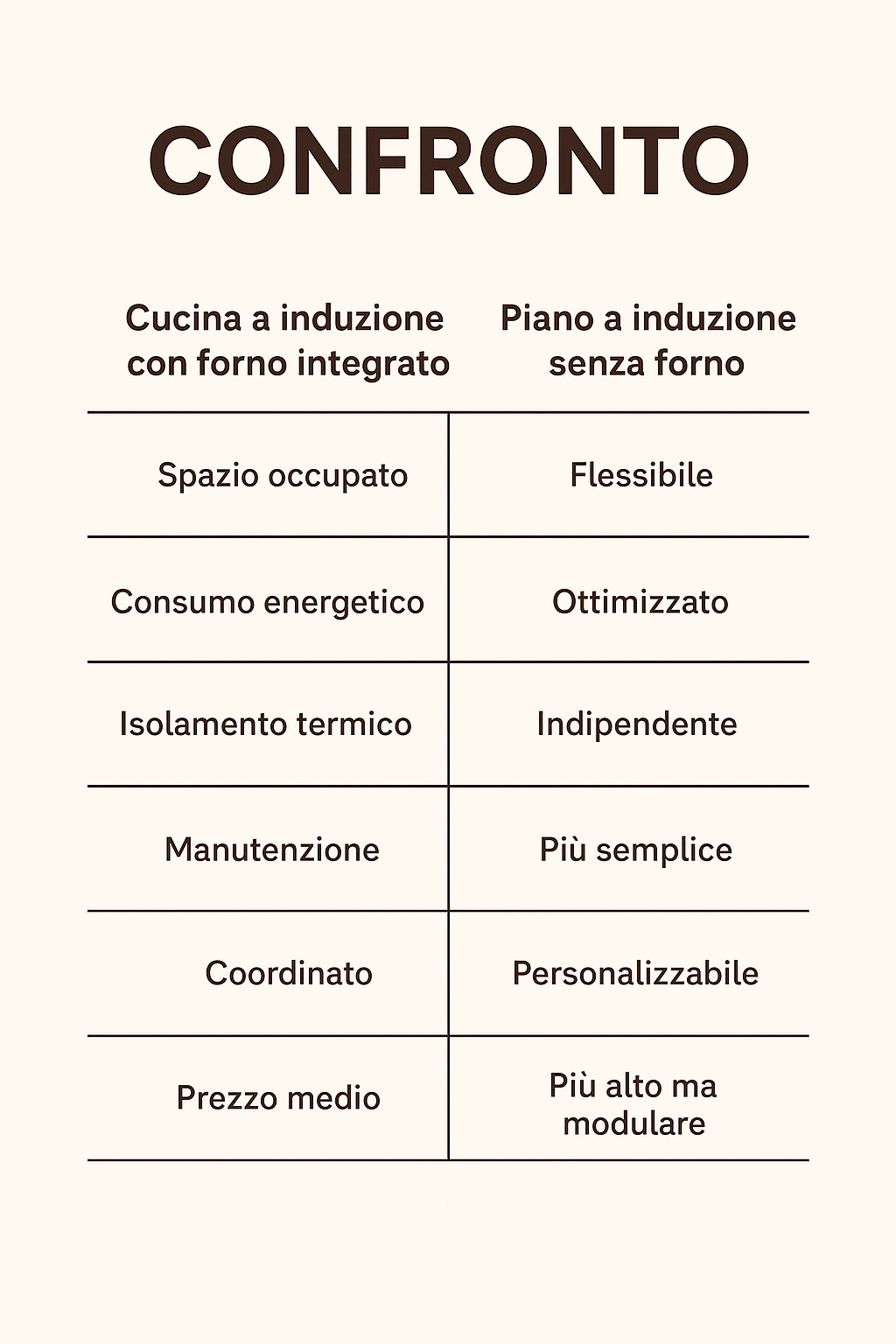
Direct comparison
| Characteristic | Induction cooker with integrated oven | Induction hob without oven |
|---|---|---|
| Space occupied | Reduced | Flexible |
| Energy consumption | Higher when used together | Optimized |
| Thermal insulation | Integrated (in Italian kitchens) | Independent |
| Maintenance | More complex | Simpler |
| Design | Coordinated | Customizable |
| Average price | More accessible | Taller but modular |
Which one to choose?
-
✅ With integrated oven : compact, elegant and functional solution, perfect for small spaces or simple everyday use.
-
⚡ Without oven : the ideal choice for those who want freedom of composition, designer kitchens and optimal energy management.
In both cases, relying on quality Italian kitchens , like those offered on Rostilia.com , means counting on a design that is attentive to insulation, compatibility and durability over time.
Technical advice from Rostilia.com
-
Check the available power of the meter ( 6 kW is recommended if you use the oven and hob together).
-
Use quality ferromagnetic pans with a thick, even bottom.
-
Keep the ventilation channels between the oven and the hob free: this improves the performance and life of the appliance.
-
When purchasing, choose models with forced ventilation and thermal safety sensors .
FAQ – Frequently Asked Questions about Induction Cooking
1. Can an induction cooktop interfere with an electric oven?
In well-designed models (like the Italian ones), no. Magnetic shielding and thermal insulation prevent any interference.
2. Do I need a more powerful meter to use the hob and oven together?
Yes, at least 4.5 kW is recommended, better still 6 kW , to avoid tripping the meter during simultaneous use.
3. Do induction cooktops also heat the worktop?
No, the heat is generated directly in the bottom of the pan. The surface remains warm, never hot.
4. Can I install an oven under any induction hob?
Yes, as long as the oven is ventilated and thermally insulated . Italian models comply with this compatibility.
5. Does induction cooking consume less energy than gas?
Yes, because it transforms over 90% of the electrical energy into heat, while gas disperses up to 60% of the heat.

Leave a comment
All comments are moderated before being published.
This site is protected by hCaptcha and the hCaptcha Privacy Policy and Terms of Service apply.