Induction cooktops are among the most popular solutions today for those seeking efficiency, safety, and modern design. But when choosing an induction cooktop , you're faced with two main options: freestanding models and built-in models .
Understanding the differences, costs and energy consumption can help you choose the best option for your kitchen.
Freestanding Induction Cooktops: What They Are and Why You Should Choose Them
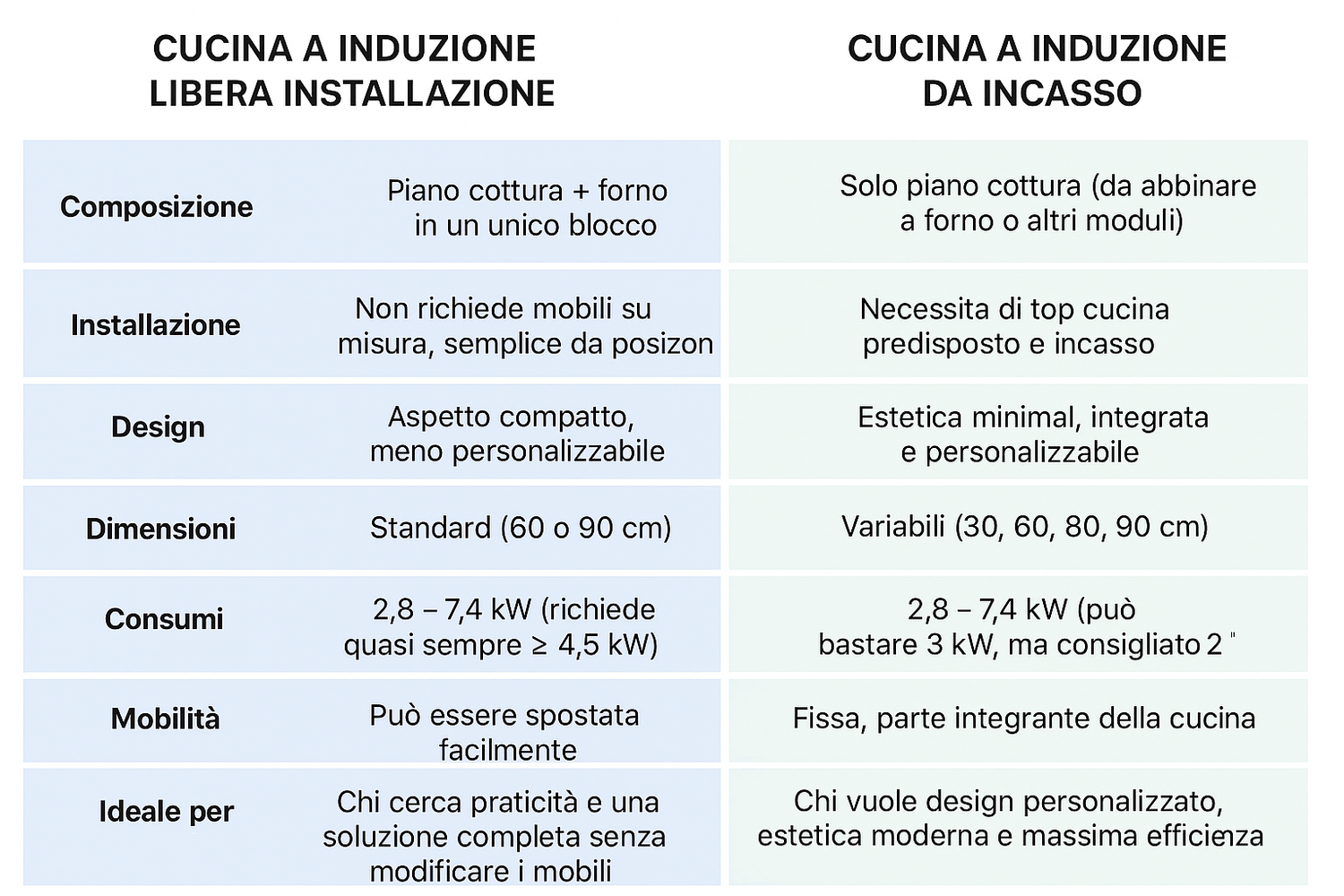
The freestanding cooker is a unique appliance that integrates an induction hob and oven.
-
Advantages :
-
It does not require custom furniture.
-
It can be easily moved in case of relocation or renovation.
-
Available in various sizes (generally 60 or 90 cm).
-
-
Ideal for : those who want a practical and compact solution without having to modify the kitchen furniture.
👉 Discover the selection on offer with Rustilia
Built-in Induction Cookers: Functionality and Style
A built-in induction hob is a hob integrated into the kitchen countertop. It can be combined with a built-in oven or other modules.
-
Advantages :
-
Minimal aesthetics and perfect integration with the furnishings.
-
Greater choice of sizes (30, 60, 80, 90 cm).
-
Possibility to combine different appliances according to your needs.
-
-
Ideal for : those looking for customization, design and maximum efficiency.
👉 Discover Rustilia's selection of built-in induction cookers
Cost Differences on Quality Products
-
Freestanding induction cookers : average prices between € 1,500 and €4,500 , including oven.
-
Built-in induction cooker : hob from €250 to €1,300 , to which must be added the cost of the oven and installation.
👉 In general, the built-in solution is less expensive , but offers greater aesthetic freedom.
Consumption and Kilowatts Required
One of the most important aspects concerns the electrical system.
-
A standard induction hob has a power between 2.8 kW and 7.4 kW , depending on the number of active zones.
-
On average, for domestic use, 3 kW is sufficient, but if you often cook on multiple zones, a 4.5 or 6 kW meter is recommended.
-
Freestanding cookers have similar features to built-in hobs, but almost always require 4.5 kW to ensure full efficiency.
👉 Check if your system is eligible!
Which One to Choose?
-
If you are looking for practicality and convenience , a free-standing induction hob is better.
-
If you are aiming for design, customization and high-level cuisine , choose the built-in hob .
FAQ – Frequently Asked Questions
1. Does induction cooking consume more energy than gas?
No, it is more efficient: it transforms over 90% of the energy into heat, compared to 40-50% with gas.
2. Can I use traditional pans on an induction hob?
Only if they have a magnetic bottom. Otherwise, they need to be replaced.
3. Is it necessary to increase the power of the meter?
It depends: for occasional use 3 kW may be enough, for intense use 4.5-6 kW is better.
4. What is the average lifespan of an induction hob?
Approximately 10-15 years, if well used and maintained.
5. Is it better to buy a freestanding kitchen or a built-in hob right away?
If you have a pre-furnished kitchen, freestanding is more practical; if you're furnishing from scratch, built-in offers more aesthetic options.

Leave a comment
All comments are moderated before being published.
This site is protected by hCaptcha and the hCaptcha Privacy Policy and Terms of Service apply.