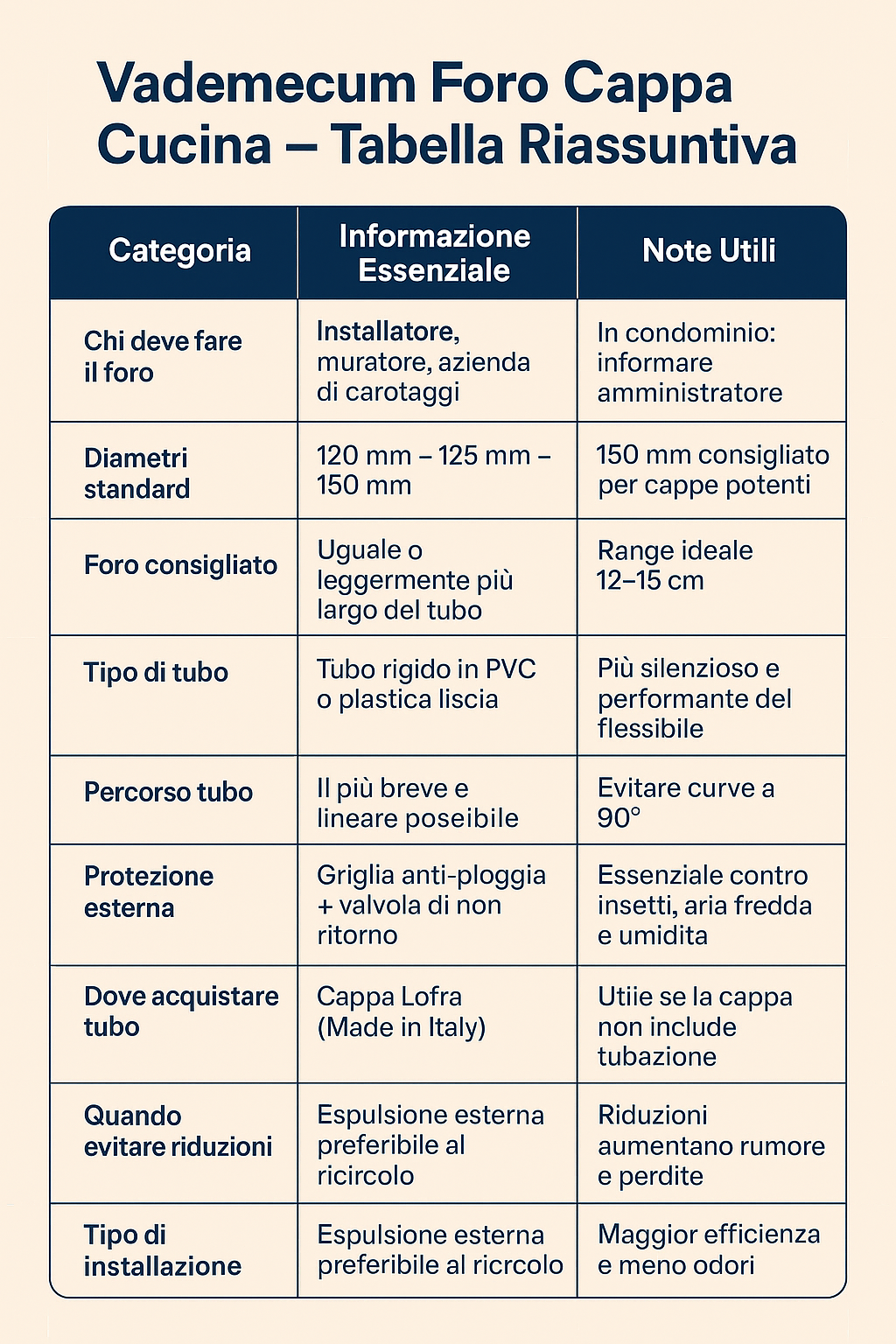
Creating the external vent for your kitchen hood is a crucial step to achieving good extraction, reducing noise and humidity, and ensuring a clean and comfortable kitchen. This Rustilia guide provides everything you need to know: who can do it, what diameter to choose, how to protect the external vent , where to purchase the hood duct if it isn't included, and a focus on Lofra hoods , a symbol of Italian excellence.
Quick answers
-
Who makes the external hole in the hood? A professional: an installer, a bricklayer, or a company specializing in core drilling.
-
Ideal hole diameter: 120, 125, or 150 mm depending on the hood. 150 mm is the best choice for powerful hoods.
-
How it is protected externally: with a rain grille, non-return valve and anti-infiltration seal.
-
Where to buy the pipe if it is not included: from Leroy Merlin (120/125/150 mm pipes in PVC or aluminum).
-
Recommended brand: Lofra hoods, 100% Made in Italy, aesthetically refined and high quality.
1. What is the external hood vent and why is it so important?
The external hole is the passage that allows the extractor hood to expel fumes, vapours, odours and humidity to the outside.
Without a proper hole or with a tube that is too narrow:
-
the hood sucks less,
-
the noise increases,
-
condensation is created,
-
the kitchen remains more humid and with bad smells.
This is why it is essential to respect the diameter indicated by the manufacturer and install the correct pipe .
2. Who should make the external hole of the hood?
The hole in the external wall must be made exclusively by a professional :
✔️ Specialized installer
Perfect if you are already purchasing the hood: it often offers the “installation + hole + connection” package.
✔️ Bricklayer or construction company
Ideal for renovations or when more significant masonry work is required.
✔️ Core drilling company
The right choice if the wall is very thick, made of reinforced concrete or if an extremely precise hole is needed.
💡 In condominiums : it is good practice to inform the administrator, especially if the external grill is visible on the facade.
3. What diameter is needed for the hood hole?
Most hoods use three standard diameters:
-
Ø 120 mm
-
Ø 125 mm
-
Ø 150 mm → recommended for modern and more powerful hoods
The hole should be equal to or slightly larger than the diameter of the pipe (usually 12–15 cm ).
Reducing the pipe diameter is not recommended : it creates backpressure, increases noise and reduces flow rate.
👉 Rustilia Council
If you are setting up the system now and the hood has not yet been chosen: prepare a 150 mm hole .
This way you can fit any top-of-the-range model without limitations.
🔎How to maintain a hood
4. How to create the hole for the hood (explained simply)
Here are the typical steps performed by a professional:
-
Inspection and tracing
-
Identify the point where the hood will come out.
-
The shortest possible path between the hood and the exit is checked.
-
-
Coring
-
A core drill with a circular tip (crown) of the correct diameter is used.
-
Drilling occurs from the inside out or vice versa, depending on the wall.
-
-
Inserting the tube
-
A rigid tube of the same diameter as the hood is inserted (120/125/150 mm).
-
-
Sealing
-
The pipe is fixed and sealed to prevent infiltration.
-
-
Application of the external grid
-
The exit is protected with anti-rain and anti-return devices.
-
5. External hole protection: what is really needed?
An unprotected external hole can let in:
-
rain,
-
insects,
-
small animals,
-
cold air,
-
odors from common reeds or headwinds.
To avoid this, three elements are needed:
✔️ External rain grille
Made of plastic or metal, with slanted fins and often an insect screen.
✔️ Non-return valve
It opens when the hood is on and closes automatically when it is off.
✔️ Professional sealing
With silicone or weatherproof mortar.
👉 These elements also improve the silence and efficiency of the hood.
🔎Discover the models suitable for external extraction
6. Is the hood hose not included? You can find it at Leroy Merlin.
High-end or built-in hoods are often sold without ducting , because it must be chosen based on the diameter of the hole and the route.
At Leroy Merlin you can easily buy:
-
rigid PVC pipes (quieter and more efficient),
-
flexible aluminum pipes ,
-
diameters 120 / 125 / 150 mm ,
-
curves, elbows, reducers and external grilles.
Rustilia Technical Council
Always prefer rigid and smooth pipes:
📌 less noise → 📌 better suction → 📌 less grease deposits.
7. Lofra hoods: Italian excellence to match your kitchen
If you are looking for a superior quality hood, Lofra hoods are a guarantee:
-
100% Made in Italy production,
-
modern or classic design (Dolcevita line),
-
sturdy materials,
-
excellent suction,
-
perfect integration with premium kitchens.
A Lofra hood looks best with a 150mm exhaust, quality rigid pipe and perfectly sealed external hole.
🔎Discover Lofra's history in Italian kitchens
8. FAQ – Frequently asked questions about the external hole of the hood
1. Can I make the external hole myself?
Not recommended: professional tools are required and you could damage the wall.
2. What is the most used diameter?
Today the most common is 150 mm , because modern hoods require higher flow rates.
3. Can I reduce the pipe from 150 to 120 mm?
Best avoided: it reduces efficiency and increases noise. Reductions should only be used when there are no alternatives.
4. Is the external grill absolutely necessary?
Yes: it protects against bad weather, insects and drafts.
5. The hood does not have a pipe: can I buy it separately?
Of course. Leroy Merlin offers pipes, bends, reducers, and grilles in all standard diameters.
6. Is it true that Lofra is Made in Italy?
Yes, Lofra is an Italian brand with over 60 years of history and products made entirely in Italy.

Leave a comment
All comments are moderated before being published.
This site is protected by hCaptcha and the hCaptcha Privacy Policy and Terms of Service apply.