
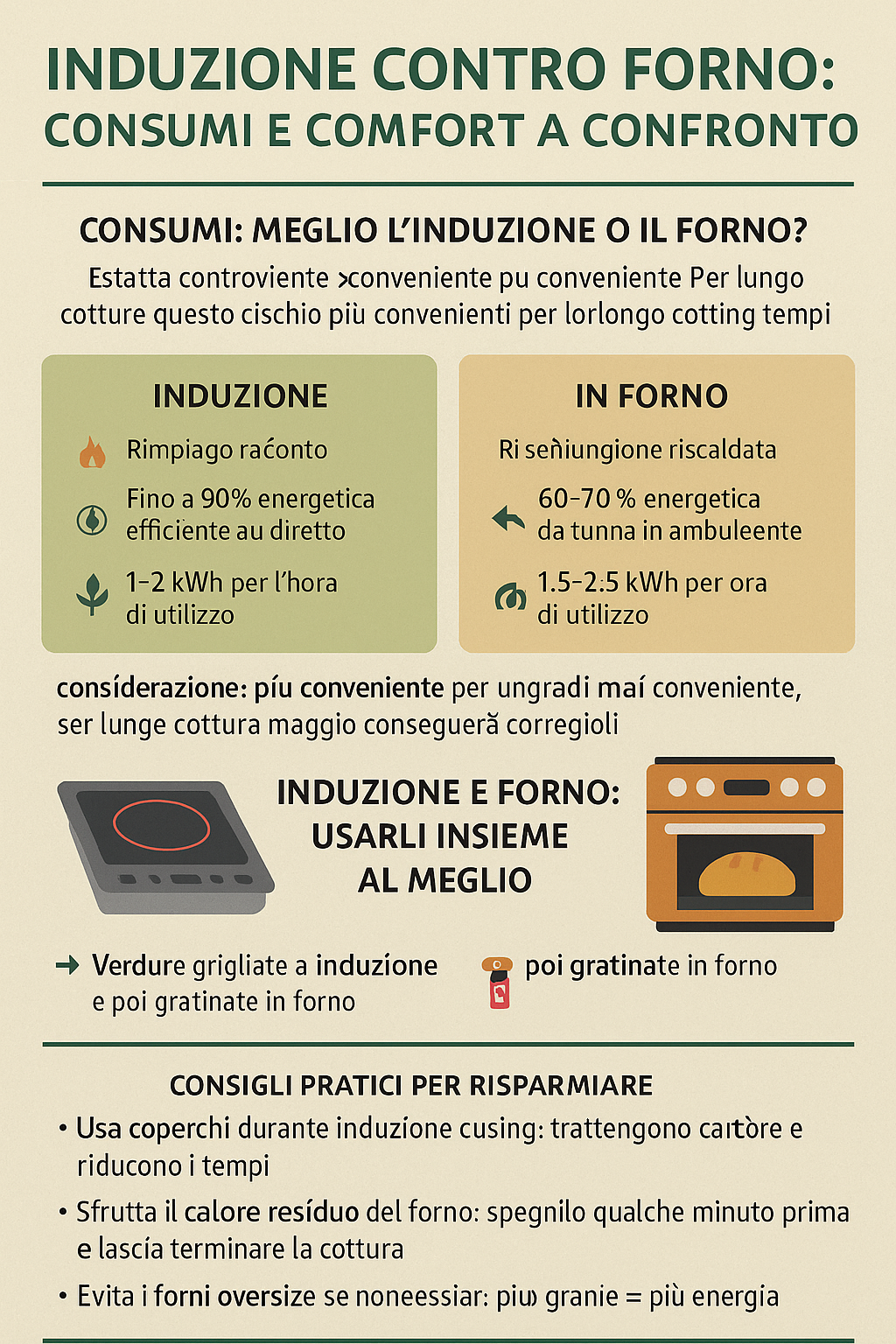
Induction vs. Oven: Comparing Consumption and Comfort
Induction cooktop and oven : which is the most efficient and convenient choice in terms of consumption, time, and cooking quality?
In recent years, more and more people are turning to induction cooking , attracted by the speed, precision, and greater safety compared to traditional stovetops. But when it comes to preparing complex dishes or long cooking times, the oven remains a crucial ally. Induction and oven: consumption and comfort must therefore be evaluated together to make informed choices in the kitchen.
Energy consumption: is induction or oven better?
Induction hobs and electric ovens are both powered by electricity, but they behave very differently:
🔹 Induction:
-
It reaches high temperatures in seconds.
-
It has an energy efficiency of up to 90% , because the heat is transferred directly to the pan.
-
It consumes around 1-2 kWh per hour of use , but cooking time is often halved compared to traditional methods.
🔹 Electric oven:
-
It takes longer to warm up.
-
It has an energy efficiency of 60-70% , because part of the heat is dispersed into the environment.
-
It can consume 1.5-2.5 kWh for every hour of use , especially if used for long cooking sessions.
➡ Conclusion : For quick dishes, induction is much more convenient. For long cooking times, the oven must be managed carefully (e.g., no prolonged preheating, multiple cooking sessions at once).
Comfort and ease of use
| I wait | Induction hob | Electric oven |
|---|---|---|
| Speed | 🔥 High | ⏱️ Medium/slow |
| Precision | 🎯 High (with timer and sensors) | 🎯 Good, but less controllable |
| Cleaning | ✨ Easy (glass ceramic hob) | 🧽 More complex (grids and walls) |
| Safety | 🔒 High (no flame, auto-off) | 🧯 Medium (beware of high temperatures) |
| Versatility | 🍳 Great for pans, woks, pots | 🍕 Perfect for pizza, roasts, desserts |
Induction cooktop and oven: how to use them together
It's not a competition: induction and oven often complement each other. An example?
👉 Induction grilled vegetables and then oven-baked with breadcrumbs and extra virgin olive oil.
👉 Chicken browned in an induction pan , finished in the oven for perfect internal cooking.
Practical tips for saving money
-
Use lids when cooking on induction: they retain heat and reduce cooking times.
-
Take advantage of the residual heat of the oven : turn it off a few minutes early and let it finish cooking.
-
Avoid oversized ovens unless necessary: bigger = more energy.
-
Choose induction-safe pans with a thick bottom for better results.
Conclusion
Induction or oven? It depends on what you cook and how you manage your appliances.
➡ If you're looking for speed, efficiency and safety , induction is unbeatable.
➡ If you need even cooking and complex dishes, the oven remains essential.
The real breakthrough? Learning to combine them intelligently to optimize consumption and improve the cooking experience.