Combined gas and induction hob: opinions, pros/cons, and buying guide (with a 90 cm focus, AEG vs. Lofra)
The combined gas and induction hob combines the responsiveness and flame control of gas with the speed and efficiency of induction . It's ideal for those who cook frequently, want continuity even in the event of incompatible pans or power outages, and want to reduce time and energy consumption for quick preparations. If you have space, the 90 cm size offers ergonomics and well-spaced zones. AEG (high quality, advanced electronics, smart functions) and Lofra (sturdy construction, professional look, solid grids) are two different and complementary approaches: choose based on digital comfort vs. "pro" robustness .
What is a gas and induction hob (and why should you choose one)
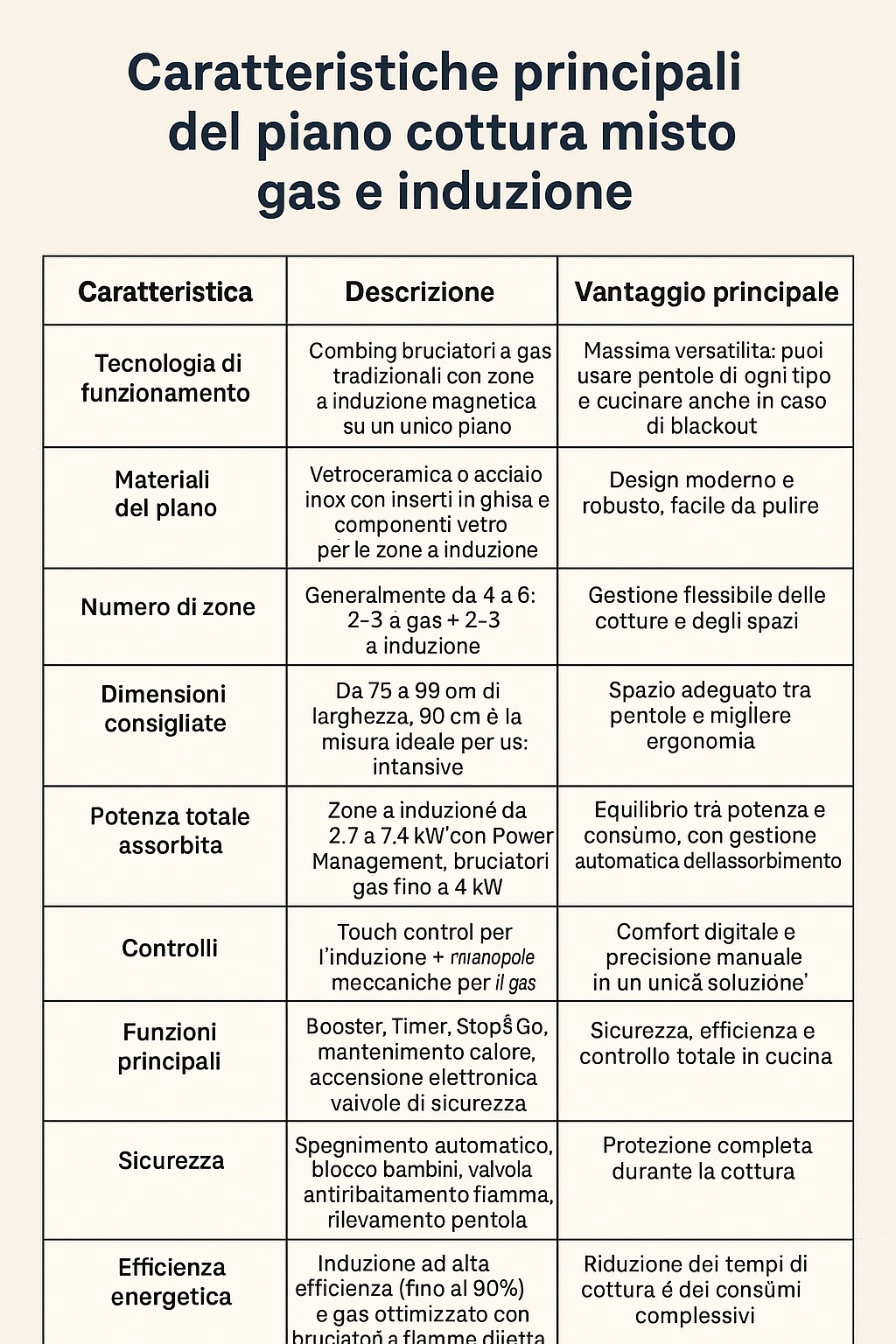
Definition. A unique top that integrates gas burners and induction zones .
Who is it suitable for?
-
You want versatility : wok/open flame for sautéing and roasting, induction for quick boiling and precise cooking.
-
You have mixed pans: some non-ferromagnetic (copper/aluminum) you still use on the gas.
-
You're interested in continuity : if the power goes out → you have gas; if the gas runs out → you have induction.
Main pros (recurring opinions from expert users):
-
Speed : Induction brings to the boil in just a few minutes.
-
Control : the flame remains unbeatable for certain techniques (wok, flambéing).
-
Efficiency and cleanliness : on induction the glass stays cooler and can be cleaned in a flash.
-
Safety : safety valves on the gas + sensors/auto-off in induction.
Cons to consider:
-
Higher cost than a gas-only or induction-only top.
-
Power consumption : Induction zones may require a suitable electrical contract (often ≥ 4.5–6 kW in Italy if you use multiple zones together).
-
Space : These are tops that perform best at 75–90 cm .
Focus on the 90 cm format: ergonomics, built-in installation and systems
Why 90 cm is popular with serious cooks:
-
More breathing room between large pots (saucepan + wok + pasta pot).
-
Convenient asymmetrical layout: gas/induction sides or “L” layout that avoids bumping handles.
Pay attention to these practical details:
-
Recessed hole : check the manufacturer's template (width/depth and top reinforcements).
-
Ventilation : Gas burners require vents and clearance from cabinets; induction requires ventilation for the electronics.
-
Absorption : a pair of induction zones + booster may require power limitation (power management function) if the meter is 3 kW.
-
Connections : compliant gas provision + dedicated electricity line with adequate magnetothermal/differential switch .
🔎Discover the range chosen for you by Rustilia
AEG vs. Lofra: Two Philosophies Compared
Fair premise: AEG products are good : refined finishes, reliable electronics, truly useful smart features. Lofra focuses on solid construction and professional styling , much loved by those who want a "chef-style" aesthetic.
1) Design & Construction
-
AEG
-
Quality glass/ceramic with finished edges , clean brushed steels.
-
Minimal and easily integrated into contemporary kitchens; smooth touch slider controls.
-
-
Lofra
-
Thick steel , heavy cast iron grates , metal knobs: a “ cooking machine ” feel.
-
Professional/Italian pro aesthetic that marries classic or industrial kitchens.
-
2) Gas burners & induction zones
-
AEG
-
Burners optimized for efficiency and uniform heat distribution.
-
Induction with incisive boosters , fine level management, often Bridge function to join two zones.
-
-
Lofra
-
Often powerful burners (even triple crown on selected models), excellent for woks and aggressive searing.
-
Solid induction, less “gadgets” and more essentiality .
-
3) Controls, functions and “digital comfort”
-
AEG
-
Hob2Hood (where present) for dialogue with the hood: very convenient.
-
Individual timers , heat maintenance , stop&go , child safety lock.
-
Integrated power management for absorption limits.
-
-
Lofra
-
Ergonomic and precise throttle grips ; satisfying “mechanical” feel.
-
More essential electronics: less automation, more immediacy.
-
4) Noise & cleanliness
-
AEG : generally quiet induction; easy-to-clean surfaces; “flat” design that helps.
-
Lofra : Sturdy , wide grates (great for large pots) require a few extra minutes for thorough cleaning .
5) Assistance, spare parts, value
-
AEG : widespread network and spare parts availability typical of large groups; high perceived value in the "modern premium" market.
-
Lofra : a historic Italian brand with a strong manufacturing reputation; a value for those seeking mechanical longevity and professional style.
In summary, practical choice:
-
Choose AEG if you want advanced electronics , smart comfort, silence , and a contemporary minimal aesthetic.
-
Choose Lofra if you prefer a professional feel , powerful burners , heavy-duty components and a designer kitchen look.
User reviews (what demanding users say)
-
“Since I have the mixed : sauces and slow cooking on the gas , boiling/risottos in induction: times halved .”
-
“ 90 cm format: no more clashing handles.”
-
“With AEG I like the control and smart functions; with Lofra I love the stability of the grills and the powerful flame.”
🔎Find out what combined gas and induction cooking consists of
Pros and cons in quick decision format
Pro
-
Total versatility (each technique finds its “track”).
-
Induction speed/efficiency + gas control.
-
High safety (valves + sensors + auto-off).
Against
-
More demanding price and installation.
-
Adequate electrical power required.
-
Size: works best from 75 cm upwards (ideal 90 cm).
Purchase checklist (save it and use it in store)
-
Space : 90 cm top available? Also check the installation hole .
-
Systems : gas compliant + dedicated electricity line; power management can be activated.
-
Layout : Do you prefer 2 gas + 2 induction , 3 gas + 2 induction , or a central island layout?
-
Pots : How many are ferromagnetic ? Do you need the Bridge function ?
-
Style : minimal smart (AEG) or pro robust (Lofra) ?
-
Assistance : check the network and spare parts availability in your area.
-
Safety : child lock, valves, automatic shut-off.
-
Noise/ventilation : Listen to a demo, check air vents and installation shims.
Quick FAQ (SGE/AI-Overview ready)
Does the mixed plan consume a lot of energy?
Induction is more efficient than gas; consumption depends on usage and the contracted power . Power management limits peak absorption.
Can I use gas and induction at the same time?
Yes. All you need is an adequate electrical system and compliant gas ventilation.
Do you need to change all the pans?
No: ferromagnetic ones work with induction; copper/aluminum work perfectly on gas .
Is induction only or a mixed hob better?
If you do a lot of different techniques and want redundancy , mixed is the best compromise.
Isn't 90cm too much?
In reality, it's the most balanced format for using 3–4 large pots without taking up too much space. If the base allows, it's an investment in ergonomics .