Induction hob in a camper or boat? Yes, but be careful!
Induction cooking on the go: a natural evolution or a calculated risk?
More and more travelers, campers, and sailors are choosing induction for cooking. The reason is simple: no flames, fewer odors, more efficiency . But when you're traveling on four wheels or surrounded by water, every watt counts.
Is it really a good idea to install an induction hob in a camper or on a boat?
The answer is yes, but only if all the energy and structural parameters are taken into account .
In this article, we’ll explore everything you need to know, from energy management , to choosing the right plan , to a final FAQ to answer common user questions.
Why use an induction hob in a camper or boat?
The main advantages:
-
🔥 Safety : No open flames, no risk of gas leaks.
-
🧽 Easy to clean : Smooth surface and washable in an instant.
-
⚡ Energy efficiency : direct heat transfer to the pan (~90% versus ~60% for gas).
-
🧊 No wasted heat : especially useful in summer or in small spaces.
-
🌍 Zero local emissions : Cooking without gas improves indoor air quality.
✨ A plus? Some modern models are equipped with intelligent absorption limiters , perfect for battery or inverter systems.
Pay attention to energy management: what to consider before purchasing
The real limitation of mobile induction is the available energy . A standard hob can absorb between 1200 and 2000W per zone , and if you use an inverter or batteries, it's essential to be precise.
1. Batteries: AGM or Lithium?
-
Lithium (LiFePO4) batteries are ideal: they have a longer life, deep discharge and optimal charging speed.
-
AGM batteries can be fine, but they don't always handle prolonged high drain.
2. Inverter: yes, but pure wave
-
A pure sine wave inverter is essential to avoid damage to the electronic circuits of the hob.
-
The rated power of the inverter should be at least 1.5 times the maximum absorption of the hob (e.g. 2000W → 3000W inverter).
3. Charging: solar or charging station?
-
If you rely on photovoltaic , evaluate how much energy you can produce and store in a day.
-
If you are connecting to an external or marine outlet , check the rating of the onboard fuses (often 6-10A).
How to choose the right induction hob for your camper or boat
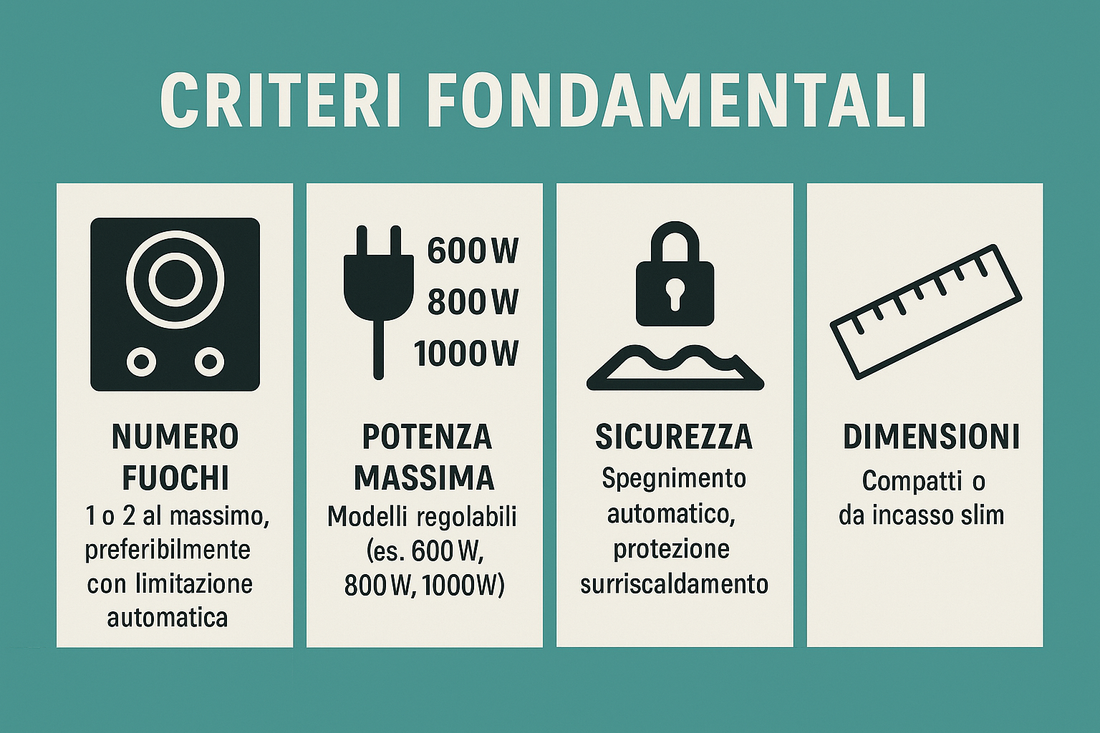
Key criteria:
| Characteristic | Advise |
|---|---|
| 🔥 Number of fires | 1 or 2 at most, preferably with automatic limiting |
| ⚡ Maximum power | Adjustable models (e.g. 600W, 800W, 1000W) |
| 🔒 Security | Automatic shutdown, overheat protection |
| 📏 Dimensions | Compact or slim built-in |
| 🔄 Smart control | Timer, power levels, “Keep Warm” mode |
Advanced Tips
➤ Analyze your consumption
With home automation devices such as Victron Cerbo GX, EcoFlow App or Smart Shunt , you can monitor:
-
Battery charge status
-
Real-time consumption of the induction hob
-
Residual margins of use
➤ Set up energy routines
Schedule cooking for peak solar power or when you're connected to the grid . You can also use dynamic power hobs, which automatically adjust to available energy.
FAQ – Frequently Asked Questions
👉 Can I use an induction hob with a 1500W inverter?
Only if you limit the hob's power to less than 1200W and use it alone. Otherwise, the inverter will go into protection mode or burn out.
👉 Does the induction hob only consume energy during cooking?
Yes, but be careful: peak consumption occurs when you turn it on and in the first few minutes . This is the most critical time for the battery and inverter.
👉 What pans do you need for induction cooking in a camper?
As long as they have a magnetic bottom . To reduce weight and absorption, choose stainless steel or aluminum pans with a ferromagnetic bottom.
👉 Is a single or double floor better?
A single, adjustable burner or a double burner with intelligent wattage control is best. Never use two burners simultaneously in a camper or boat without a reinforced system.
👉 Can it be installed permanently?
Yes, but remember that the countertop must be well ventilated underneath and behind. Avoid installations where air cannot circulate.
Conclusion
An induction hob in a camper or boat is a valuable ally for cooking well and safely , but it must be chosen carefully.
Evaluate available energy , inverters , batteries , and choose a plan designed for mobility .
With Rustilia, you can count on a targeted selection of compact induction hobs , practical guides, and technical support. Contact us for a personalized consultation or browse our catalog.