
Air purifiers: the best ally for allergy sufferers
Breathing clean air is a healthy choice
The quality of the air we breathe at home is fundamental, especially for those who suffer from seasonal allergies, asthma or rhinitis .
Even domestic environments, in fact, can contain a large quantity of pollen, dust mites, animal hair and fine particles that irritate the respiratory tract.
An air purifier is the most effective solution for removing these allergens and improving indoor air quality.
How an air purifier works
An air purifier draws in ambient air, passes it through several stages of filtration, and releases it clean.
Its technological heart is the HEPA (High Efficiency Particulate Air) filter , which retains up to 99.97% of fine particles up to 0.3 microns, including those invisible to the human eye.
The purification process is generally divided into four phases:
-
Pre-filter: captures dust, hair and fur.
-
HEPA filter: blocks allergens, pollen, mites and bacteria.
-
Activated carbon filter: neutralizes odors, smoke and chemicals.
-
(In advanced models) Ionizer or UV-C light: destroys residual viruses and germs.
🔎Discover Rustilia's selection to improve the lives of allergy sufferers
Why it is useful for allergy sufferers
Those who suffer from allergies will find the purifier a valid daily support.
Thanks to multi-level filtration, the device:
-
Reduces sneezing, coughing and nasal congestion .
-
It limits the presence of pollen and mites in the environment.
-
Promotes deeper, more restful sleep .
-
It helps you breathe better all year round, not just during flowering periods.
💡 Tip: Keep the purifier in the room where you spend the most time, such as the bedroom or living room , and leave it on in automatic or silent mode for constant air exchange.
What should the best air purifier for allergy sufferers have?
Not all air purifiers are created equal.
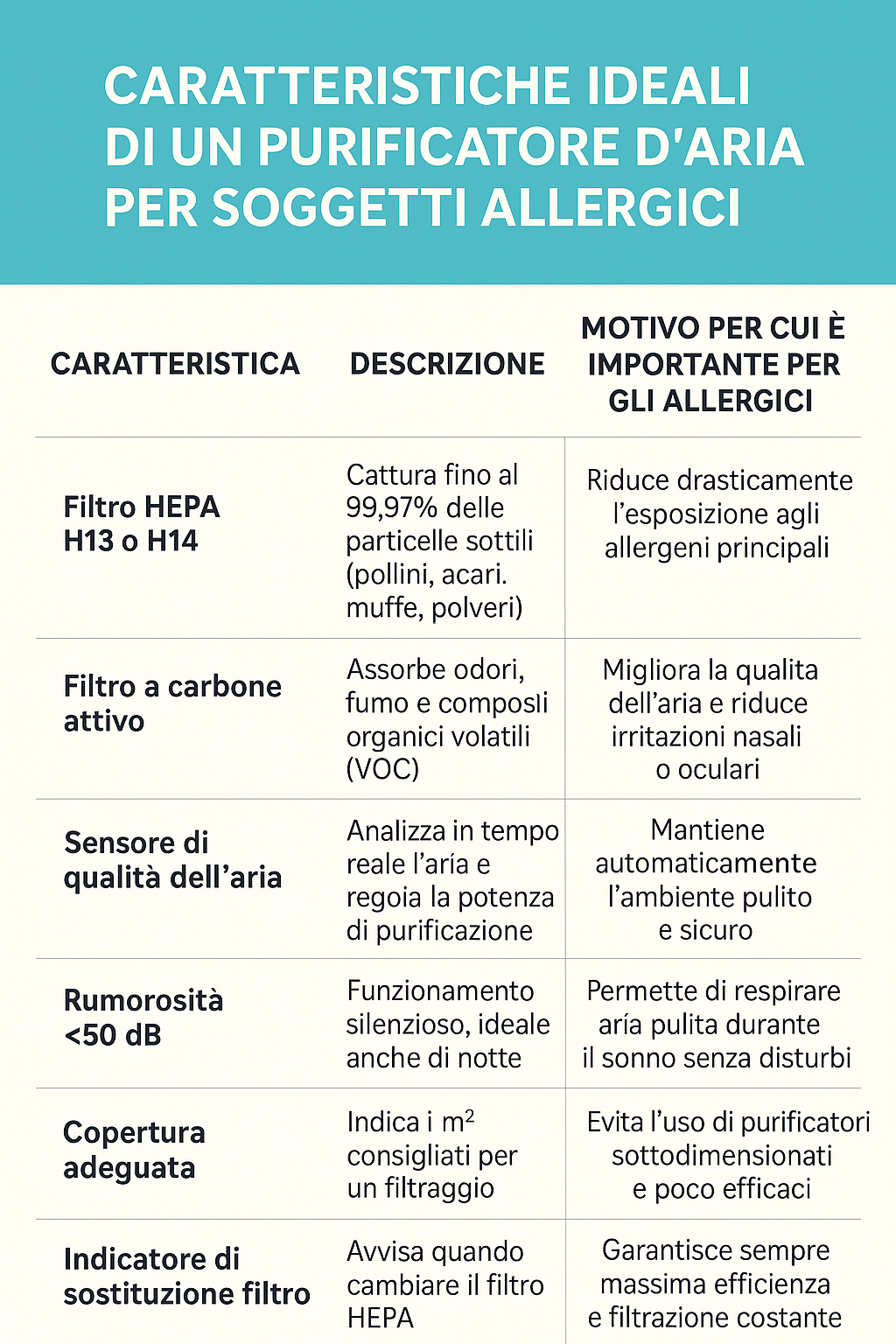
To ensure maximum effectiveness against allergens, a good device should have these characteristics:
-
HEPA H13 or H14 filter
These filter classes are the most efficient at trapping microparticles, pollen, and dust mites. Avoid models with "HEPA-like" or generic filters. -
Activated carbon filter
Essential for neutralizing odors, smoke, volatile organic compounds (VOCs) and chemical residues. -
Integrated air quality sensor
Detects pollution level in real time and automatically adjusts purification speed. -
Low noise (<50 dB)
A silent purifier is essential for those who want to use it even at night, without disturbing their sleep. -
Smart control display or app
It allows you to monitor the status of the filters and receive notifications on air quality. -
Filter replacement indicator
Notifies you when it's time to change the HEPA filter, preventing efficiency losses. -
Coverage appropriate to the room
Always check the recommended square meters: an undersized purifier will not effectively purify the entire room. -
Recognized certifications (AHAM, ECARF, Energy Star)
They ensure that the device is tested and safe for home use, even by allergy sufferers.
🔎Find out how an air purifier works
👉 In short: the best purifier for allergies is the one that combines filtering power, silence and intelligent sensors , automatically adapting to air quality.
When to change the HEPA filter
The HEPA filter should be replaced regularly to maintain the purifier's high performance.
On average, the duration varies between 6 and 12 months , but it depends on:
-
the level of domestic pollution;
-
the frequency of daily use;
-
the presence of animals or smokers in the house.
If you notice reduced airflow, persistent odors, or a warning light , it's time to replace your filter.
Don't wash or vacuum it: you risk damaging it. Always use original replacement parts to ensure maximum filtering efficiency.
FAQ – Frequently Asked Questions for Allergy Sufferers
1. Do air purifiers really help allergy sufferers?
Yes. Purifiers with a HEPA H13 or H14 filter remove almost all pollen, mites, dander, and dust, reducing respiratory and eye symptoms.
2. Where is the best place to place it if I am allergic?
In the bedroom or living room , near the breathing area (but not against the wall). In very large rooms, a second device may be necessary.
3. Does it need to be left on all day?
During pollen season or when windows are kept closed, yes: at least 8-10 hours a day or in continuous automatic mode.
4. How do I know when the HEPA filter needs to be changed?
Many models have an LED indicator or app notification. Without one, the main symptom is decreased airflow or a stale smell .
5. Can I clean the HEPA filter instead of replacing it?
No. HEPA filters are neither washable nor reusable: cleaning them reduces their effectiveness and can disperse allergens. It's best to replace them every 6-12 months.
6. Do air purifiers also eliminate cooking or pet odors?
Yes, if equipped with an activated carbon filter , which absorbs odors and chemical compounds, improving the freshness of the environment.