In recent years, more and more people are choosing to install an air purifier to improve the quality of their air at home. But what exactly does this device do? How does it work, and what real benefits does it offer? In this guide, we'll discover everything you need to know—from the HEPA filter to the health and comfort benefits.
What is an air purifier?
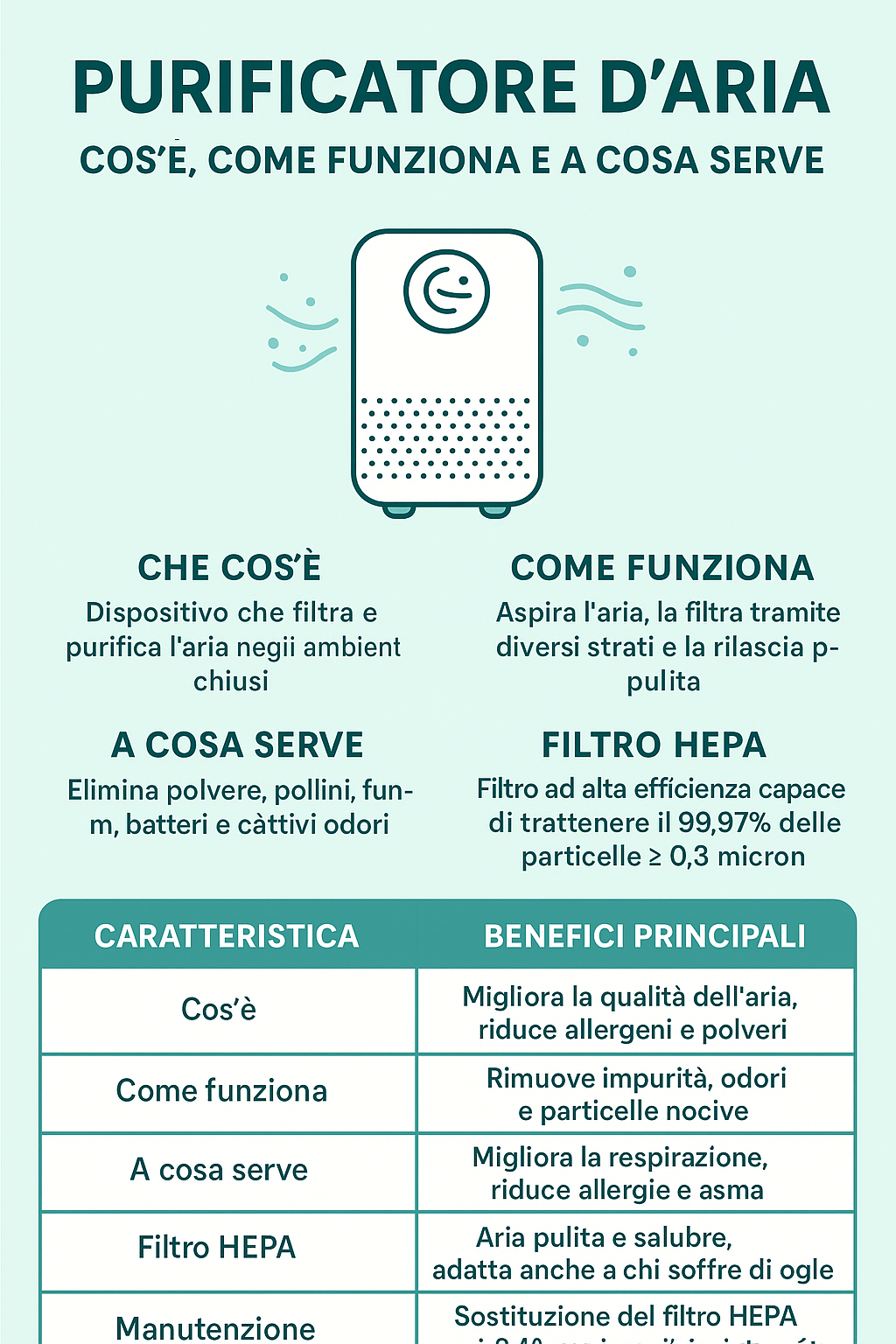
An air purifier is a household appliance designed to remove polluting particles from the air in indoor environments.
These particles may include:
-
Dust and pollen
-
Mold spores
-
Bacteria and viruses in suspension
-
Cigarette smoke
-
Household odors and volatile organic compounds (VOCs)
Its aim is to improve the quality of the air we breathe , creating a healthier and more comfortable environment, especially for those who suffer from allergies, asthma or respiratory problems.
How an air purifier works
An air purifier works by using a multi-level filtration system and a fan that draws in ambient air.
Here are the main steps:
-
Suction: The device captures the surrounding air.
-
Filtration: the air passes through several filter layers (including HEPA, activated carbon or pre-filters).
-
Emission: the purified air is recirculated, free from impurities.
Some more advanced models also integrate ionizers , UV-C lamps , or smart sensors that detect air quality in real time and automatically adjust the device's power.
🔎Discover the chosen line with Alexa voice command
What is an air purifier used for?
An air purifier is primarily used to reduce indoor pollutants and maintain cleaner, more breathable air .
Key benefits include:
-
Improved breathing comfort
-
Reduction of seasonal allergies
-
Elimination of smoke and bad odors
-
Preventing the spread of germs and viruses
-
Better quality of sleep
Furthermore, in cities or areas with heavy traffic, the purifier can reduce PM2.5 micro dust , which is particularly harmful to health.
The concept of air purifier with HEPA filter
The acronym HEPA stands for High Efficiency Particulate Air .
A HEPA filter is capable of retaining up to 99.97% of particles measuring 0.3 microns (one millionth of a meter) or larger.
This type of filter is the gold standard in mid- to high-end air purifiers and is also often used in hospitals, laboratories, and professional environments.
What is a HEPA filter and what is it used for?
A HEPA filter is made up of a dense network of randomly arranged microfibres, capable of capturing even micro-particles suspended in the air .
Its main function is:
-
Retain allergens, pollen and fine dust
-
Block small bacteria and viruses
-
Ensure clean and healthy air , even in closed environments with limited recirculation
To maintain maximum efficiency, the HEPA filter should be replaced periodically according to the manufacturer's recommendations (typically every 6-12 months).
Why choose an air purifier for your home?
Choosing an air purifier with a HEPA filter is a decision that concretely improves your daily health .
It is particularly recommended for:
-
Families with children or elderly people
-
People with allergies or asthma
-
Those who live in polluted urban areas
-
Anyone who has pets or smokes at home
A good quality air purifier can really make a difference, especially during the winter months or in poorly ventilated environments.
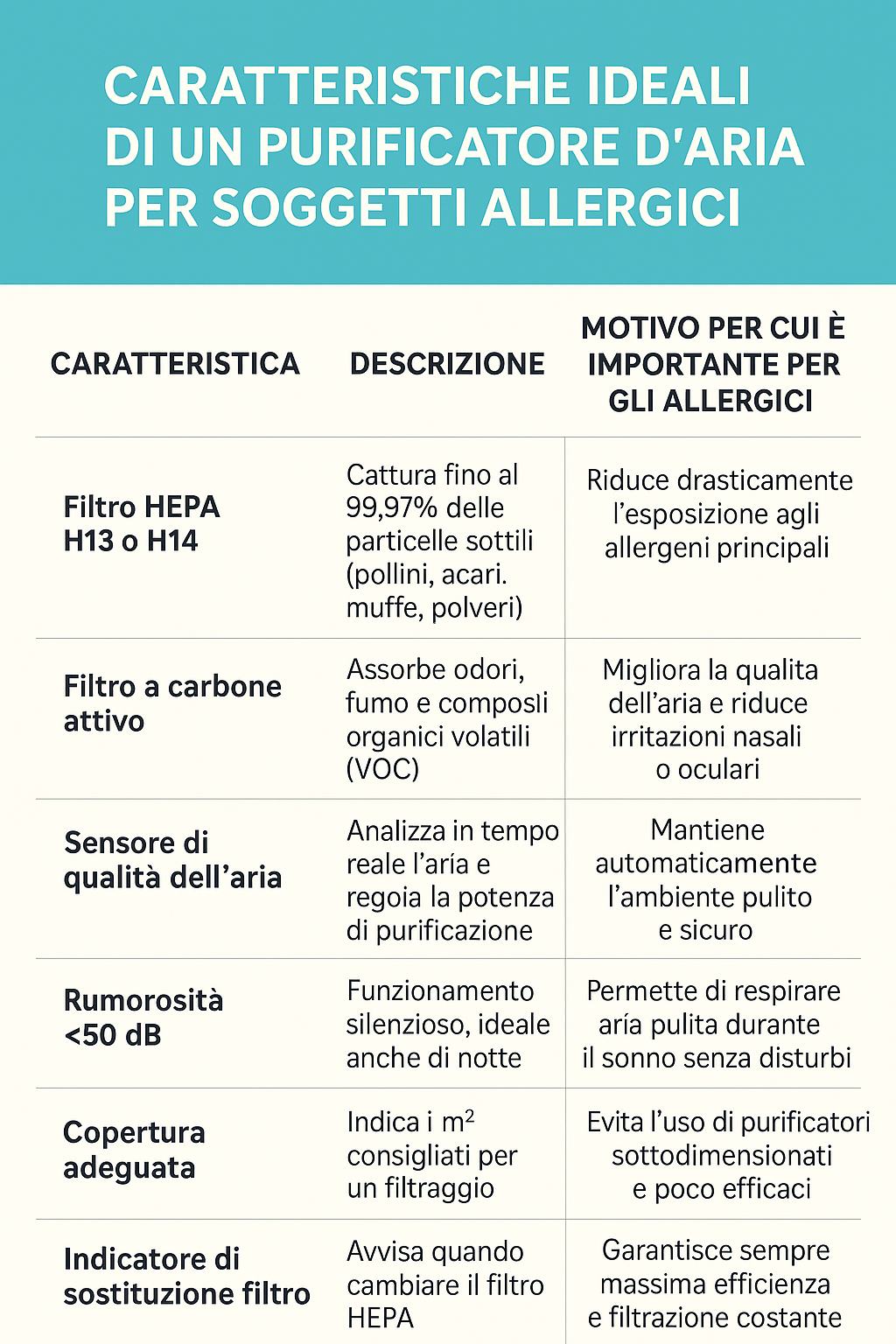
🔎Discover the benefits for allergy sufferers
❓ FAQ – Frequently Asked Questions about Air Purifiers
1. Does the air purifier also eliminate bad odors?
Yes, if equipped with an activated carbon filter, the device is able to absorb smoke, cooking odors and volatile substances.
2. Are air purifiers noisy?
Modern models are very quiet: in night mode they can emit less than 25 decibels , similar to a whisper.
3. Does an air purifier consume a lot of energy?
No, consumption is generally low — on average between 20 and 50 watts , depending on the power.
4. Can I keep it on all day?
Yes, but it is advisable to use the automatic mode to adjust the power based on the detected air quality.
5. How do you clean an air purifier?
The pre-filter should be cleaned regularly with a dry cloth or vacuum cleaner, while the HEPA filter should be replaced at the indicated times.

Leave a comment
All comments are moderated before being published.
This site is protected by hCaptcha and the hCaptcha Privacy Policy and Terms of Service apply.