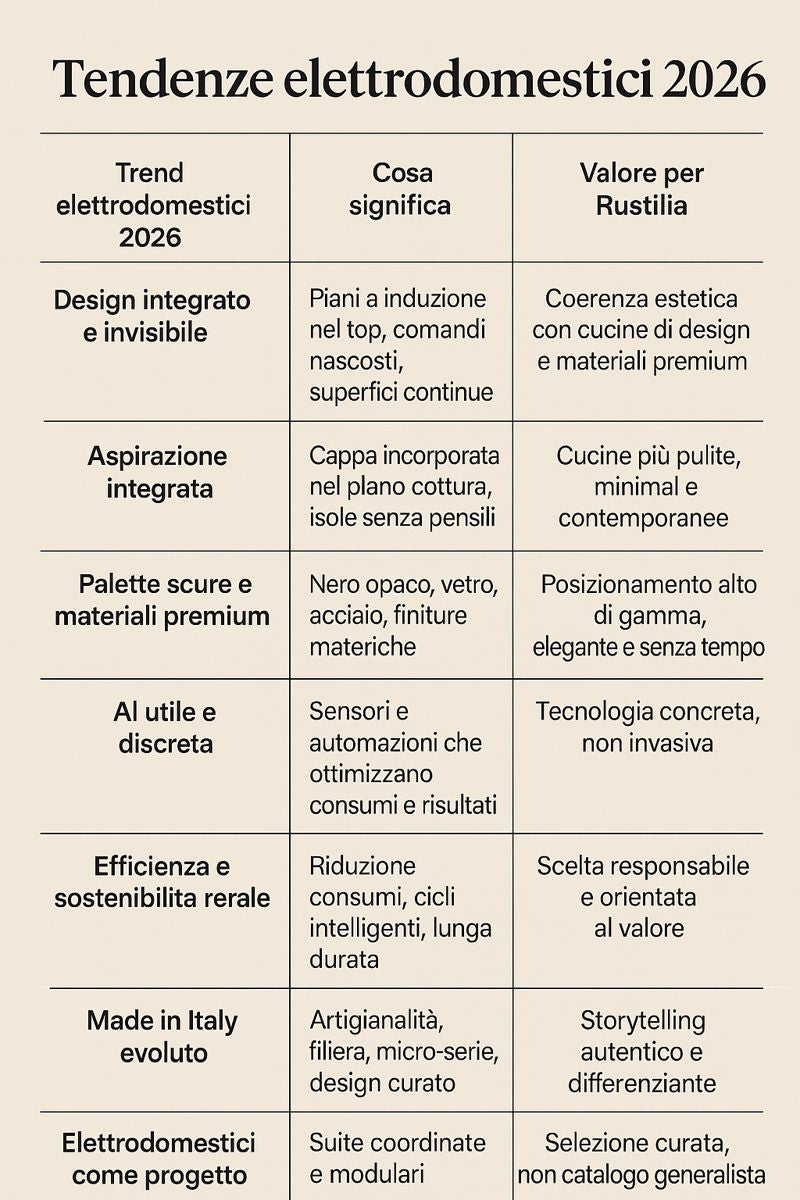
In 2026, appliances will become less and less "objects" and more and more kitchen architecture : they integrate, disappear from view, interact with materials and finishes, and add (truly) useful intelligence for consumption, maintenance, and results. The strongest trends arise from the intersection of minimal design , sustainability/efficiency , and supply chain craftsmanship —a perfect breeding ground for Rustilia-style "curated" selection.
In 30 Seconds: What Will Really Matter in 2026
-
Invisible or nearly invisible appliances (induction hobs integrated into the countertop, controls that appear only when needed).
-
Clean-lined kitchens : solid black, glass, steel, compact and modular units.
-
Integrated extraction (induction hob with built-in hood) for islands “without wall units”.
-
AI and sensors to reduce waste (energy, water, cooking/washing errors) and increase shelf life.
-
Made in Italy as an experience : finishes, materials, details, collaboration with designers/brands, small series, customization.
1) Design 2026: “less appliance, more kitchen”
The new luxury is visual continuity
In 2026, premium is recognized by one thing: seamless surfaces and components that don't interrupt the overall look. Two strong examples:
-
Invisible induction hob : technology integrates into the countertop, freeing up design. This is one of the most design-driven trends because it shifts the focus from the controls to the material (Dekton/ceramics/advanced laminates).
-
Disappearing hoods : the extraction enters the hob, improving aesthetics and sightline, especially in kitchens with islands.
Black, glass, steel and “tactical” materials
At EuroCucina a clear direction was seen: full black , new materials, modularity and coordinated suites (oven + compact + hob + extraction) for a coherent look.
What it means for Rustilia: a selection of appliances that blend seamlessly with the kitchen (dark palettes, metals, matte finishes) and enhance the furnishing project.
2) AI in 2026: fewer "gadgets", more results and controlled consumption
The jump is not “the appliance that talks”, but the one that:
-
recognizes burdens/habits,
-
optimize cycles,
-
Report maintenance before it's a problem,
-
Improve fuel consumption and performance with real data .
At IFA 2025, many launches insisted on AI + efficiency + minimalism (especially in the European built-in).
Rustilia filter (very practical): in 2026, AI is valuable only if it brings 1–2 measurable benefits (time, energy, results). If it's just a "sideline" app, it's not a trend: it's just noise.
3) Sustainability that can be seen and measured: efficiency + durability
The keywords 2026:
-
energy (reduced real consumption, intelligent cycles),
-
water (optimized washing),
-
longevity (materials, assistance, spare parts, “repairable” design).
EuroCucina explicitly linked innovation to sustainability and high-tech ; IFA placed a strong emphasis on efficiency and automation.
What this means for buyers: Rather than “eco,” they’ll look for solid specifications, sensible warranties, and consistent performance over time.
🔎Discover a historic brand
4) Made in Italy 2026: craftsmanship + industry, not nostalgia
The Made in Italy that will work in 2026 is not just a “flag”: it is attention to detail , supply chain, materials and the ability to customize.
Examples of directions consistent with this trend:
-
collaborations between design/brands and appliances (the appliance becomes a cultural object, not just a technical one).
-
Italian specialists in steel and workmanship (aesthetics, robustness, consistency with premium kitchens).
How to tell it in Rustilia style (without sounding like an “advertisement”)
-
“ Who did it ” (district, processes, materials).
-
“ Because it is beautiful ” (lines, proportions, finishes).
-
“ Because it’s convenient ” (cleaning, maintenance, daily use).
-
“ Because it lasts ” (components, assistance, spare parts).
🔎Discover Italian Bugatti Design
5) The 7 home appliance trends of 2026
-
Invisibility and integration into the top (integrated induction/continuous surfaces).
-
Integrated extractor hood for open-plan kitchens and clean islands.
-
Coordinated suites and modularity (compact, built-in, uniform look).
-
AI to optimize cycles and consumption (not just “smart homes”).
-
Premium materials and dark palettes (black, glass, steel, matte).
-
A “quieter” connected kitchen : automations that reduce micro-actions (open/close, dry better, signal maintenance).
-
Contemporary Made in Italy : finishes, micro-series, collaborations with designers, supply chain storytelling.
How to Choose the Right Appliances in 2026
-
Consistent aesthetics (one palette, one finish, one logic: everything appears “designed”).
-
Invisible technology (if the feature is advanced, the interface must remain clean).
-
AI with a clear advantage : either it improves results, or it reduces consumption, or it saves you time.
-
Materials and maintenance : ask yourself “does it clean in 30 seconds?” (in 2026 this is a premium criterion).
-
Assistance and spare parts : this is true sustainability.
FAQ
What is the most “design” trend of 2026?
Integrated/invisible induction and extraction integrated into the hob: transform the appliance into a surface, freeing up the kitchen architecture.
Is AI in home appliances really necessary?
Yes, when it automatically optimizes consumption and results (cycles, sensors, predictive maintenance). If it's just another app, no.
How do you distinguish a true “Made in Italy” in 2026?
From materials, workmanship, finishes, supply chain, and customization capabilities (not just the brand). Collaborations with designers and metal/processing specialists are a strong signal.

Leave a comment
All comments are moderated before being published.
This site is protected by hCaptcha and the hCaptcha Privacy Policy and Terms of Service apply.