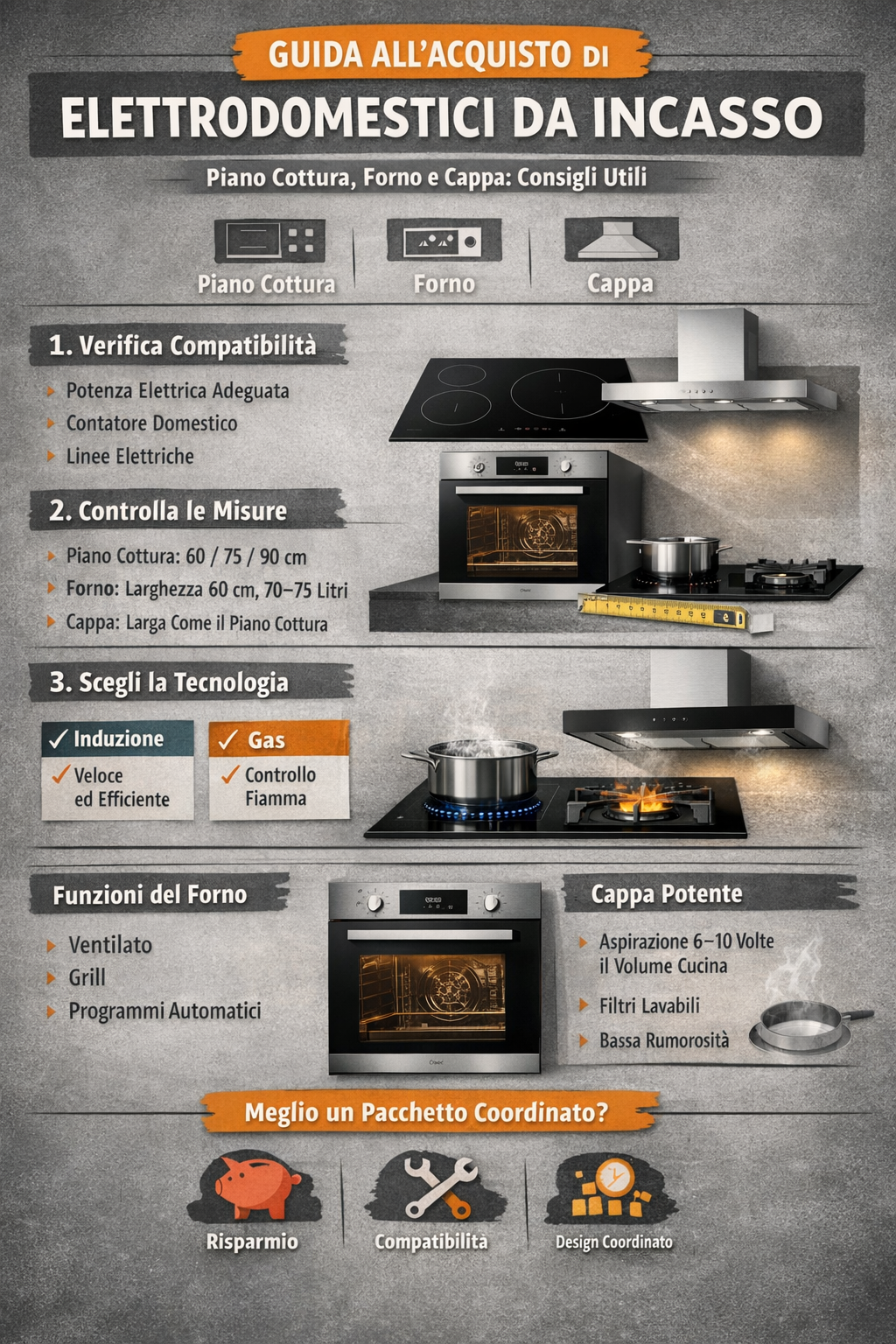
When designing a new kitchen or renovating an existing one, choosing built-in appliances is one of the most important decisions.
The classic package consisting of a hob, oven and hood must guarantee:
-
technical compatibility
-
adequate performance
-
energy efficiency
-
aesthetic harmony in the kitchen
Purchasing a coordinated package can simplify installation and often also allows you to obtain more advantageous economic conditions .
Let's see what are the main aspects to consider before purchasing.
1. Check the compatibility between appliances
Before purchasing a built-in package, it is important to check that the hob, oven and hood are compatible with each other .
The main elements to evaluate are:
Available electrical power
An induction hob can require a high power rating, often between 3 and 7 kW . If you also use an oven at the same time, you should check:
-
the power of the home meter
-
the presence of the power limiter function
-
the distribution of power lines
This avoids the risk of overloads or tripping of the meter during cooking.

2. Check the dimensions of built-in appliances
Built-in appliances are generally designed with standard dimensions , but it is always important to check the measurements before purchasing.
The most common sizes are:
Hob
-
60 cm (standard size)
-
75 cm
-
90 cm
Built-in oven
-
standard width: 60 cm
-
average capacity: 65–75 litres
Extractor hood
-
width at least equal to the hob
-
ideally 10–20 cm wider to improve suction
It is also important to check:
-
depth of the worktop
-
available space in the kitchen cabinet
-
distance between hob and hood
3. Choose the hob technology
The hob is the most used appliance in the kitchen and the choice of technology greatly influences the cooking experience.
The most popular solutions are:
Induction hob
Main advantages:
-
very rapid heating
-
high energy efficiency
-
greater security
-
ease of cleaning
Induction is now the preferred solution in modern kitchens.
Gas hob
Main advantages:
-
immediate flame control
-
compatibility with all pans
-
lower initial cost
It is still very common in traditional kitchens.
4. Evaluate the oven functions
The modern oven offers numerous functions that improve the quality of cooking.
The most useful features are:
-
multifunction ventilation
-
grill
-
automatic programs
-
combined cooking
-
pyrolytic or catalytic cleaning
A capacity between 70 and 75 litres is ideal for most families.
Those who cook often should also consider:
-
telescopic guides
-
temperature probe
-
dedicated programs for bread, pizza and roasts
5. Choose a hood with adequate extraction
The hood has the task of eliminating fumes, odors and vapors produced during cooking.
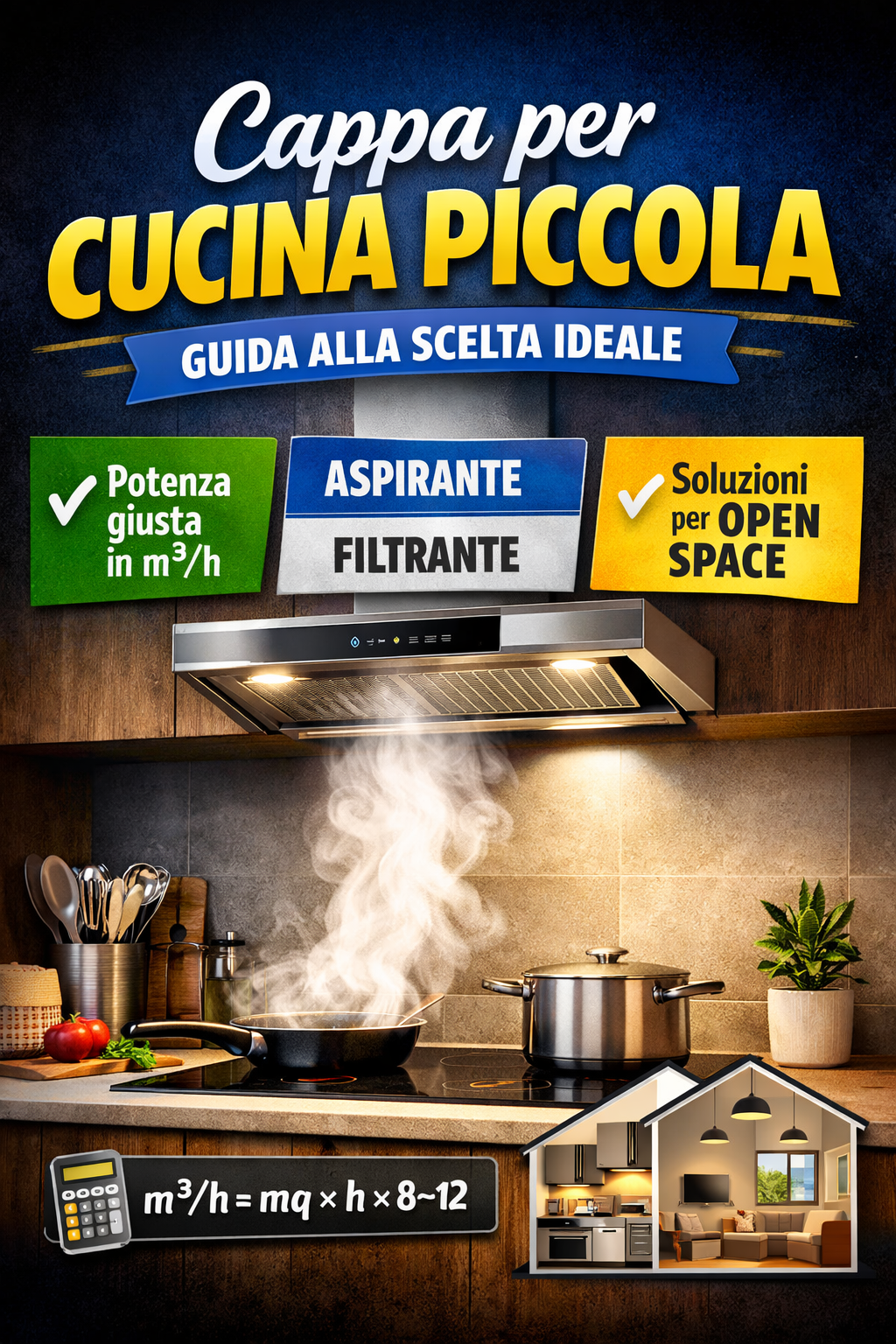
The suction power should be approximately 6–10 times the kitchen volume per hour .
Example:
A 20 m² kitchen with a height of 2.7 m has a volume of approximately 54 m³ .
In this case the hood should have an extraction capacity of at least 350–500 m³/h .
Other important aspects are:
-
noise level
-
washable steel filters
-
LED lighting
Find out how to choose a kitchen hood based on the size of the room
6. Why choose an appliance package
Buying a hob, oven, and hood together offers several advantages.
The main ones are:
-
often cheaper price
-
coordinated design
-
greater technical compatibility
-
easier installation
Many manufacturers offer dedicated promotions on built-in appliance packages .
7. The importance of design in the modern kitchen
In addition to technical performance, aesthetics also play an important role today.
The most common finishes are:
-
black glass
-
stainless steel
-
matte black
All-black appliances are particularly popular because they integrate easily into contemporary kitchens.
Learn how to design with ChatGpt
FAQ – Frequently Asked Questions about Built-in Appliances
Is it worth buying a package of built-in appliances?
Yes, in most cases it's worth it. Packages often include a matching hob, oven, and hood , offering more affordable prices and greater technical compatibility between products.
What is the standard size of a built-in oven?
The most common size is 60 cm wide , with an internal capacity of between 65 and 75 litres .
How powerful should a kitchen hood be?
The hood should have an extraction capacity of at least 6–10 times the kitchen volume per hour . For an average kitchen, the ideal power is between 350 and 600 m³/h .
Which is better: induction or gas hob?
It depends on your cooking habits.
Induction is more efficient, faster and safer, while gas offers immediate flame control and is compatible with all pans.
How much space should there be between the hob and the hood?
The recommended distance is generally:
-
55–65 cm for induction hobs
-
65–75 cm for gas hobs
The exact distance depends on the manufacturer's specifications.

Leave a comment
All comments are moderated before being published.
This site is protected by hCaptcha and the hCaptcha Privacy Policy and Terms of Service apply.